Česká republika
 Deutschland
 Österreich
 United Kingdom
 Suomi
 France
 Magyarország
 Italia
 Polska
 România
 Україна
 Europe

Ballistic glasses – what they are and who needs them

Military operations, law enforcement, range training, airsoft — in every one of these environments there is a real and specific risk of eye injury from fragments, ricochets, wind-driven debris or BB projectiles. Standard sunglasses handle none of it — they weren't designed to. Ballistic glasses are. This guide explains what sets them apart from ordinary eyewear, which standards actually guarantee protection, how to match the lens tint to lighting conditions, and who genuinely needs them.
In short (TL;DR)
- Ballistic glasses ≠ sunglasses — they are certified personal protective equipment (PPE), typically made from 2–3 mm polycarbonate or Trivex, tested to withstand high-energy impacts.
- The certifications that matter: ANSI Z87.1+ (US standard, "+" = high impact), EN 166 B (European standard, B = ballistic resistance at 45 m/s), MIL-PRF-31013 (US Army, the strictest).
- "Tactical" labelling means nothing without a certificationmark on the frame or lens — check before you buy.
- Lens material: polycarbonate is the standard — impact-resistant, lightweight, affordable. Trivex is optically superior and slightly more resistant, but costs more.
- Lens tints: clear = indoors or night, yellow/amber = low light and fog, grey/smoke = bright sun, mirror = glare and snow, orange/vermillion = airsoft and range use.
- Anti-fog coating is not optional — fogged lenses in a critical situation are worse than no lenses at all.
- Who needs them: military and law enforcement, airsoft players (mandatory at most UK sites), competitive shooters, anyone working in explosive or high-debris environments.
What are ballistic glasses and how do they differ from ordinary eyewear?
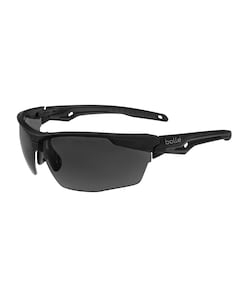
Ballistic glasses — also called tactical protective eyewear, shooting glasses or ballistic eye protection — are personal protective equipment (PPE) designed to shield the eyes from high-energy fragments, ricochets, reflected projectiles and other mechanical threats. Unlike standard sunglasses or sports eyewear, they have been tested to a defined certification standard, verifying the exact velocity and energy at which the lens must remain intact.
The critical difference is not merely lens thickness, but the combination of material and frame engineering. Ballistic lenses are typically made from polycarbonate or Trivex — high-toughness thermoplastics with exceptional impact absorption — while the frames are constructed to absorb and distribute energy on impact, rather than shattering into secondary fragments that could cause further injury.
Standards and certifications: what they actually test
Certification standards for ballistic eyewear set the test conditions precisely — projectile type, mass, velocity, impact point, and the pass/fail criteria. Understanding the three main standards helps you match protection to use case:
| Standard | Region | Test method | Key marking |
|---|---|---|---|
| ANSI Z87.1+ | USA (widely referenced in UK/EU) | 6 mm steel ball at 51.8 m/s (170 ft/s) | "+" suffix = high impact rated; no "+" = basic only |
| EN 166 / BS EN 166 B | Europe / United Kingdom | Steel ball at 45 m/s | B = ballistic resistance; F = basic mechanical strength |
| MIL-PRF-31013 | US Army (professional military) | .22 calibre projectile, 5.8 g at 427 m/s | Listed on US Army APEL (Approved Protective Eyewear List) |
| MIL-DTL-43511D | US Army (sunglasses) | Combat sunglasses specification | Categories I–IV by tint and transmission |
For airsoft and competitive shooting, ANSI Z87.1+ or EN 166 B are sufficient and widely required at organised events. For professional military and law enforcement use, MIL-PRF-31013 certification and APEL listing are the relevant benchmarks.
Lens material: polycarbonate vs Trivex
The lens material is the core of ballistic eye protection — it determines impact resistance, optical clarity, weight, and scratch resistance.
Polycarbonate is the industry standard. It offers exceptional toughness, a refractive index of 1.586, and outstanding impact resistance at a fraction of the weight of glass. The trade-off is optical distortion at the lens periphery in lower-quality products, and a relatively soft surface that requires a hard anti-scratch coating. Virtually all certified ballistic glasses in the mid-price segment use polycarbonate.
Trivex (a urethane-based monomer) provides comparable ballistic resistance with a higher base optical clarity (refractive index 1.532) and slightly lower density — making lenses marginally lighter. The optical quality advantage is most noticeable on peripheral vision and during long-duration wear. Cost is higher and availability more limited, but for professional use where both optical precision and protection matter, Trivex is worth the premium.
Lens tints: which colour for which conditions
Lens tint significantly affects contrast perception, depth of field and situational awareness in different lighting environments. Choosing the wrong tint doesn't just affect comfort — in operational conditions it can reduce your ability to read terrain, spot movement or identify targets at distance.
| Tint | Light conditions | Best for |
|---|---|---|
| Clear | Indoor, night, low light | Night operations, indoor range work, CQB environments |
| Yellow / amber | Overcast, fog, dawn/dusk | Low-light fieldwork, forest airsoft, morning/evening range sessions |
| Grey / smoke | Bright daylight | Outdoor operations, open-field shooting, driving in sun |
| Mirror coating | Intense glare, snow, water | Mountain operations, arctic environments, maritime roles |
| Orange / vermillion | Variable, airsoft environments | Enhances BB contrast, airsoft CQB and woodland, range target work |
Key features to look for
Anti-fog coating
Fogging during physical exertion or when transitioning between temperatures is among the most common complaints with tactical eyewear. A lens that fogs at the critical moment eliminates situational awareness precisely when it matters most. Look for a manufacturer-certified anti-fog treatment — not just "fog resistant" without further specification — or models with side-vented frames that allow passive airflow to reduce condensation.
UV protection
Even clear ballistic lenses should block 99–100% of UV radiation (UV400 standard). Long-term UV exposure damages the retina without any visible warning symptom — particularly relevant in mountain, arctic or open-water environments where reflected UV is significantly increased.
Compatibility with other kit
If you're wearing ballistic glasses with a helmet, comms headset or balaclava, verify compatibility before committing. Some wide-frame and wrap-around models interfere with headset arms or don't sit correctly under helmet brow padding. Modular systems with interchangeable lenses — such as the ESS Crossbow, Oakley SI M Frame 3.0 or Revision Sawfly — offer the most flexibility for mixed kit configurations.
Prescription inserts
For those requiring vision correction, two options are practical: ballistic frames with an internal adapter for a prescription insert (rx insert system), or lenses manufactured to your prescription while maintaining ballistic certification. Wearing prescription spectacles inside ballistic glasses is not recommended — the dual-frame combination reduces stability and creates comfort problems over extended wear.

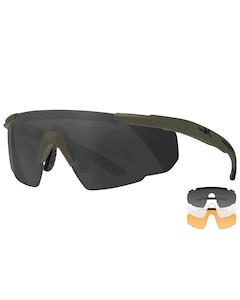

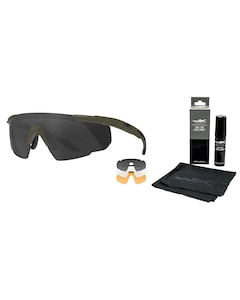


Who needs ballistic glasses?
- Military and law enforcement personnel — professional use in operational conditions, training and tactical exercises. Ballistic eye protection is standard PPE across most armed forces and increasingly mandated for law enforcement operations.
- Airsoft players — high-powered airsoft replicas can cause serious eye injuries from direct hits at close range. Certified ballistic eyewear is mandatory at the vast majority of organised UK airsoft sites.
- Competitive and sport shooters — ricocheting fragments from targets, ejecting brass cases and any muzzle debris create real risk at every range session, regardless of discipline.
- Industrial and specialist workers — demolition, pyrotechnics, explosive environments and construction in hazardous conditions all present fragment risks where ballistic-rated eye protection is the appropriate specification.
A well-chosen pair of ballistic glasses is one of the highest value-per-weight items you can carry — the protection they provide in the rare moment it's needed vastly outweighs the minimal inconvenience of wearing them habitually.
FAQ
Can I use ballistic glasses as everyday sunglasses?
Yes. Ballistic-rated polycarbonate lenses with UV400 protection and a suitable tint fully replace standard sunglasses while providing significantly greater mechanical protection. The only practical trade-offs are a potentially higher price point and, in some models, a more tactical aesthetic than everyday fashion eyewear.
What's the difference between ANSI Z87.1+ and EN 166 B?
Both certify impact resistance, but the test parameters differ. ANSI Z87.1+ uses a 6 mm steel ball at 51.8 m/s; EN 166 B uses a steel ball at 45 m/s. MIL-PRF-31013 is the most demanding, simulating a .22 calibre ballistic projectile. For airsoft and sport shooting, either ANSI Z87.1+ or EN 166 B is appropriate; for professional military or law enforcement, APEL listing and MIL-PRF-31013 are the relevant standards.
Do ballistic glasses work with a prescription?
Yes — most professional tactical eyewear offers either a dedicated rx insert adapter system, or the option of ordering lenses ground to your prescription while maintaining full ballistic certification. Wearing standard prescription glasses underneath ballistic frames is not recommended as it compromises both fit and protection.
How do I clean ballistic lenses?
Use a clean microfibre cloth and a lens-safe cleaning solution — specifically one rated for polycarbonate or coated optics. Never use paper tissue, rough fabric or glass cleaner — scratches in polycarbonate are permanent and reduce both optical comfort and structural integrity over time.