Česká republika
 Deutschland
 Österreich
 United Kingdom
 Suomi
 France
 Magyarország
 Italia
 Polska
 România
 Україна
 Europe

Pocket knife or multi-tool - which one is right for you?

Choosing between a pocket knife and a multitool comes down to one question: what will you actually use it for? If you need a lightweight, fast-access everyday carry tool where cutting is the main job, a folding pocket knife is the cleaner choice. If you regularly need pliers, screwdrivers, wire cutters, or a file alongside a blade — for field repairs, camping, DIY, or outdoor work — a multi tool pocket knife combination or a dedicated multitool will serve you better.
This guide breaks down when each tool wins, which situations call for both, and what UK knife law means for everyday carry of either.
In short (TL;DR)
- Key difference — a pocket knife is primarily a blade with optional extras; a multitool is a compact toolkit built around pliers, with a blade as one of many functions.
- Pocket knife wins — for dedicated cutting, lighter EDC, bushcraft, food prep, and quick one-handed access to the blade.
- Multitool wins — for repairs, adjustments, and technical tasks where you also need pliers, screwdrivers, wire cutters, or bits.
- UK law — a non-locking folding blade under 3 inches is legal to carry in public without a reason; a locking blade requires a legitimate purpose.
- Best of both — in most outdoor, camping, and field scenarios, carrying both tools is the most practical solution.
Pocket knife vs multitool — what is the core difference?
The fundamental difference between a pocket knife and a multitool lies in what each tool is built around. A folding pocket knife is, first and foremost, a blade — compact, light, and optimised for cutting. Additional features such as a bottle opener, small screwdriver, or saw are supplements to that primary function.
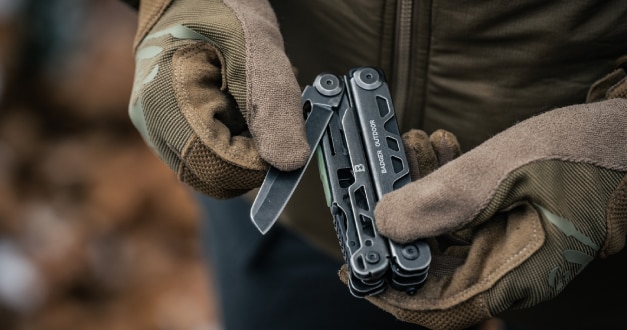
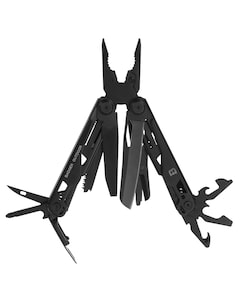
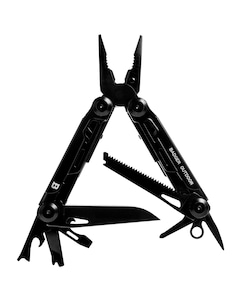
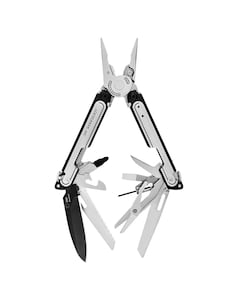
A multitool reverses this logic. Its central element is a pair of pliers — the kind of gripping and mechanical capability no pocket knife can replicate. The blade, screwdrivers, file, wire cutters, and other tools fold around the pliers as part of a compact toolkit you can carry in a pouch or pocket. A multitool is less a knife and more a miniature toolbox.
 Victorinox — Handyman Pocket Knife |
 Badger Outdoor — Thorn Multitool |
When is a pocket knife the better choice?
A folding pocket knife is generally lighter, slimmer, and faster to access than a multitool. In many everyday and outdoor situations, a well-chosen UK legal pocket knife is the more practical option. It is worth choosing a pocket knife in the following situations:
- When cutting is your primary task
A dedicated folding blade has better geometry than the compromise blade found inside most multitools — longer, thinner, and easier to sharpen to a clean edge. For cutting rope, paracord, tape, packaging, or food, a pocket knife simply performs better. - For camping, bushcraft, and outdoor work
A pocket knife is well suited to wood carving, preparing kindling, sharpening tent pegs, processing cordage, and general campsite tasks. While a fixed-blade knife is the gold standard for serious bushcraft, a quality folding knife handles the majority of light field tasks effectively. - Preparing food in camp
For slicing bread, cheese, sausage, and vegetables, or portioning food at the campfire, the clean, accessible blade of a pocket knife is simply easier to use and clean than the knife tool folded inside a multitool. - Lightweight everyday carry (EDC)
For daily tasks — opening packages, cutting tape, removing cable ties, trimming loose threads — a slim folding knife adds minimal weight and bulk. If cutting is all you need, a multitool is unnecessary.
In short: choose a pocket knife when the blade is the point. It excels for tourism, bushcraft, camping, fishing, and light EDC where simplicity and quick access to a good cutting edge matter most.


When is a multitool the better choice?
A multitool earns its place the moment you need more than a blade. It is the stronger option wherever versatility and the ability to handle minor repairs without carrying a full toolkit are what matter. Choose a multitool in the following situations:
- For equipment repairs and adjustments
Tightening a loose screw, adjusting a strap buckle, fixing a camp stove, repairing a bicycle, or sorting a minor breakdown — a multitool with built-in screwdrivers, bits, pliers, and a file solves these problems quickly. A pocket knife cannot. - When you need pliers
Pliers are the defining advantage of a multitool over any pocket knife. Gripping, bending, pulling, clamping, and holding — whether you're working with wire, hooks, cable ties, or small fixings — requires a tool that no folding knife provides. - On longer trips, expeditions, and camps
The more varied the tasks ahead, the more a multitool justifies its extra weight. Repairing tents, trekking poles, fishing gear, rucksack straps, stoves, or bike components — a good multitool handles all of these in one package. - Technical and DIY work
For anyone who regularly carries out simple maintenance or repair tasks in the field, at a worksite, or around the home, a multitool is far more practical than a pocket knife. Screwing, levering, filing, cutting wire — the right model covers most common jobs.
In short: choose a multitool when you need a versatile repair and adjustment tool alongside a blade. It is the right choice for outdoor, car, camping, travel, and everyday technical tasks where a pocket knife alone would leave you short.



Pocket knife and multitool in the context of services, rescue, and military
In security services, rescue teams, and the military, the choice between a pocket knife and a multitool differs from a standard EDC decision. It is not just about carrying comfort or function count — it is about reliability, speed of access, and fitness for specific tasks. In most professional applications, a pocket knife and a multitool do not directly compete with each other: they solve different types of problems.
Military and fieldwork
In military and field applications, a multitool often has the advantage because it covers the range of tasks involved in operating and maintaining equipment — tightening screws, adjusting load-bearing kit, working with lines, buckles, and webbing, or performing minor repairs without access to a workshop. Pliers grip and bend; screwdrivers adjust; wire cutters deal with cable ties and cord. A multitool can partially replace a basic toolkit in the field.
That said, pocket knives retain clear value alongside a multitool. They are lighter, faster to deploy one-handed, and better for cutting tasks — rope, tape, packaging, and daily camp work. In field use, both tools typically complement each other rather than compete.
Firefighting and technical rescue
In rescue operations, a multitool is a practical supplementary tool for operating equipment, making minor adjustments, and working with the kind of fastenings that require pliers or screwdrivers. A pocket knife is useful wherever quick, precise cutting of rope, tape, or light materials is needed. Both, however, play a supporting role: specialist rescue tools — seatbelt cutters, window breakers, hydraulic spreaders — are the primary equipment in life-safety situations.
Can you carry a pocket knife in the UK — what the law says
This is one of the most-searched questions on this topic in the UK, and it matters whether you carry a pocket knife, a multitool, or both.
In England, Scotland, and Wales, you may carry a non-locking folding knife with a blade of 3 inches (7.62 cm) or less in a public place without needing a specific reason. Most traditional pocket knives and the blade tools on compact multitools fall within this limit. A locking blade — regardless of length — or any blade longer than 3 inches requires a genuine, demonstrable reason to carry in public: work, a specific outdoor activity, camping, or a hobby where the tool is genuinely needed.
The practical upshot: a slim non-locking pocket knife or a compact multitool with a sub-3-inch blade is fine for everyday carry. If your folding knife or multitool has a locking blade, carry it with a purpose — on a camping trip, at a worksite — rather than as a general habit. When in doubt, keep it in your bag rather than your pocket.
Comparison table — the main differences at a glance
| Criterion | Pocket Knife | Multitool |
|---|---|---|
| Main use | Quick cutting and simple daily tasks | Technical work, adjustments, and minor repairs |
| Greatest advantage | Better blade geometry, lighter weight, faster one-handed access | Pliers plus multiple functions in a single tool |
| Most common functions | Blade, saw, opener, corkscrew, scissors (model dependent) | Pliers, screwdrivers, wire cutters, file, blade, opener, bits |
| Usefulness in the field | Excellent for cutting, food prep, and bushcraft tasks | Excellent for equipment repairs, gear adjustments, technical work |
| Usefulness in services and rescue | Useful for simple, fast cutting tasks | Useful for equipment operation, adjustments, and minor repairs |
| Weight and dimensions | Usually lighter and more compact | Usually heavier but significantly more versatile |
| UK legal carry (public) | Non-locking blade ≤3 inches — no reason needed | Same rule applies to the blade tool inside the multitool |
| Best choice when… | Cutting is the primary need and light carry matters | Pliers, screwdrivers, and repair capability are regularly needed |
Pocket knife or multitool — or both?
In practice, a pocket knife and a multitool do not have to be an either/or decision. Many people who spend time outdoors, work in the field, or carry everyday tools use both — reaching for the knife when cutting is the job, and for the multitool when a repair or technical task comes up.
A good folding pocket knife is the right daily carry for most people whose primary need is a blade. A multitool earns its extra weight whenever pliers, screwdrivers, or wire cutters are part of a regular routine. If you are choosing just one: buy the multitool first if you work on things; buy the pocket knife first if cutting is your main use case and you rarely need to grip or turn.
At MILITARY you'll find both pocket knives and multitools from brands including Leatherman, Victorinox, Gerber, SOG, and Badger Outdoor — so you can choose the right tool, or the right combination, for the way you work.
Pocket knife vs multitool — frequently asked questions
Neither is universally better — it depends on what you need it for. A pocket knife is better when cutting is your primary task: it has a longer, thinner blade with better geometry than the knife tool inside most multitools, and it is lighter and faster to deploy. A multitool is better when you also need pliers, screwdrivers, wire cutters, or a file alongside a blade — for repairs, adjustments, and technical work that a pocket knife simply cannot handle.
Yes, within limits. In England, Scotland, and Wales, you may carry a non-locking folding knife with a blade of 3 inches (7.62 cm) or less in a public place without needing a specific reason. A locking blade, or any blade longer than 3 inches, requires a genuine, demonstrable reason — such as use at work, for camping, or for a specific outdoor activity. The same rules apply to the blade tool inside a multitool.
A multi tool pocket knife typically refers to a multitool that includes a blade as one of its functions — combining the knife with pliers, screwdrivers, a file, wire cutters, and other tools in one compact folding body. Some Swiss Army knife-style tools are also described this way, as they are knife-centred designs with a wide range of additional tools. The key distinction is whether the tool is built around the blade (pocket knife) or around the pliers (multitool).
For most camping trips, a multitool offers more versatility — it handles food prep, rope cutting, gear repairs, tent adjustments, and opening tins, all in one tool. However, a dedicated pocket knife gives you a better cutting edge for food preparation and campcraft tasks. Many campers carry both: a multitool for repairs and technical jobs, and a pocket knife for cooking and precise cutting work.
For everyday carry in the UK, look for a non-locking folding knife with a blade under 3 inches — this keeps you within the law without needing to justify carrying it. Popular choices include the Victorinox Cadet, the Gerber LST, and various Opinel non-locking models. If you want a wider range of functions alongside the blade, a compact multitool such as the Leatherman Squirt or Style series fits the same legal criteria while adding screwdrivers, scissors, and a file. Browse the full range of pocket knives and multitools at MILITARY.