 Česká republika
  Deutschland
  United Kingdom
  France
  Magyarország
  Polska
  România
  Україна
  Europe
Thermal blanket — how does it work and how to use it correctly?
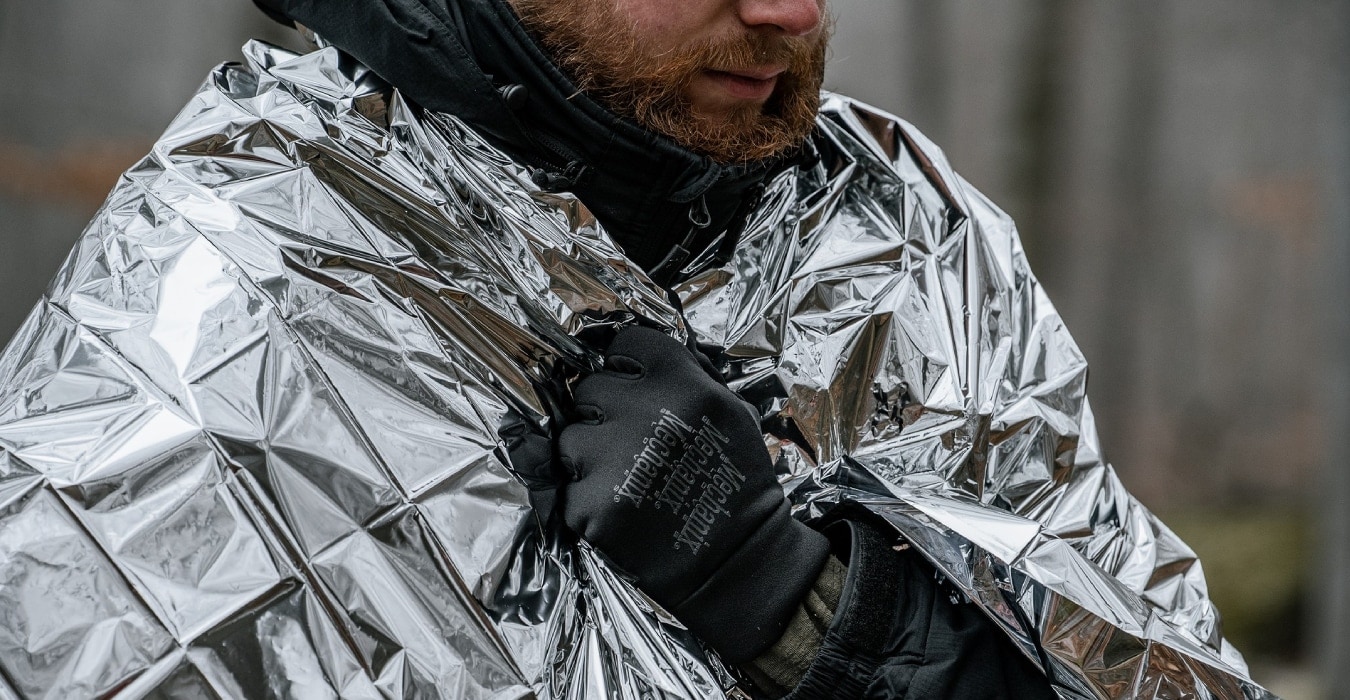
A thermal blanket, also called a space blanket, emergency blanket or NRC foil (National Research Council), is a product that is particularly useful in emergency situations, where it can save the health and even the life of a casualty. When folded it takes up very little space, so it easily fits in a first aid kit, car or go bag. Its main task is to reduce heat loss and protect the user from wind and moisture.
Thermal foil is used mainly by hikers, sports competitors, drivers and people preparing their own survival gear. However, simply having an NRC foil is not enough — it is worth knowing how a thermal blanket works, how to correctly wrap a casualty in it, and whether it really matters which side of the blanket you turn toward the body.
Quick summary
- A thermal blanket (space blanket) does not generate heat — it reflects the body's own radiant heat back and reduces heat loss.
- Silver or gold side? Both sides of a two-tone NRC foil reflect thermal radiation. The difference in insulating effect is minimal — tight, draught-free wrapping matters far more than which side faces inward.
- Always insulate the casualty from the cold ground first — even the best-applied thermal blanket is largely ineffective if they are lying directly on cold earth, concrete or snow.
- Wrap the whole body tightly, cover the head, and always leave the face uncovered to keep the airway clear.
- A single-use emergency foil blanket weighs roughly 1.8–2.1 oz (50–60 g) and packs down to the size of a deck of cards — no excuse not to carry one.
- Call 999 (UK) or 112 first — a thermal blanket is a first-aid measure, not a substitute for medical care.
What is a thermal blanket and how was it created?
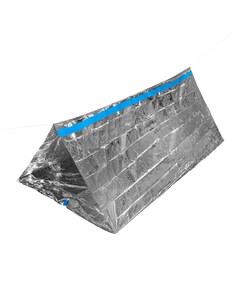
A thermal blanket is a thin sheet made of plastic coated with a very thin layer of metal, usually aluminum. Depending on the manufacturer, the base material is usually PET film (polyethylene terephthalate) or polypropylene. The metallized surface reflects a significant portion of thermal radiation, reducing heat loss or heating of the body, and the foil itself provides an additional barrier against wind and moisture.
The technology of lightweight metallized foils was developed for the space industry — hence the common name space blanket. Since the 1960s, this type of material has been used by NASA to protect spacecraft and their equipment from extreme temperature fluctuations. Over time, it also found use in rescue operations and medicine. Today, the thermal blanket is a standard piece of equipment for emergency medical teams, mountain rescue services (GOPR, TOPR), the fire service and car first aid kits compliant with DIN 13164.
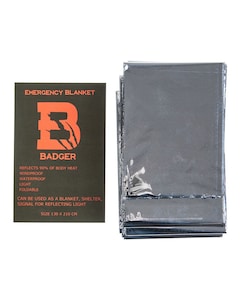
One of the biggest advantages of a thermal blanket is its low weight and compact size when folded. A standard model, when unfolded, is usually about 4 ft 3 in × 6 ft 11 in (130 × 210 cm), and its weight is about 1.8–2.1 oz (50–60 g). This means it easily fits in a first aid kit, backpack or car glove compartment and can be carried every day without practically increasing the weight of your gear. However, you should remember that the exact dimensions and weight depend on the manufacturer and the specific model.




How does a thermal blanket work — physics in a nutshell
Does a thermal blanket really heat you up? This is one of the most common questions. The answer is: no. A thermal blanket does not generate heat – it only helps retain the heat that the body is already producing.
A thermal blanket:
- Reflects radiant heat – the metallized surface of the NRC blanket reflects up to 90% of the radiant heat emitted by the body, reducing its loss. Thanks to this, the foil helps slow down the cooling of the body and reduces the risk of hypothermia.
- Protects against wind and moisture – wind and wet clothing greatly accelerate heat loss. The blanket creates a barrier that reduces this effect.
- Reduces heat loss through convection – that is, it limits the exchange of warm air near the skin with cold air from the surroundings.
Space blanket silver or gold — which side faces the body?
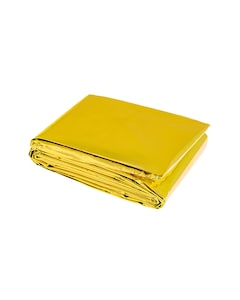
Many people believe that the color of an emergency blanket determines whether it "warms" or "cools". In reality, it works a bit differently. Both the silver and the gold side of an NRC foil reflect radiant heat. The gold side is not "non-reflective", and the color difference does not mean that one side "warms" and the other "cools".
In a typical NRC blanket, the color of the side should not be treated as the primary factor determining how effectively it keeps you warm. The color difference results mainly from the construction of the metallized foil and its optical properties. In practice, the difference in insulating effect between the two orientations is minimal — tight, draught-free wrapping is far more important.
However, color can matter for visibility and signalling. The foil reflects light, which means it can also be used to signal your position. The silver surface reflects light well, while the gold one can be more visible against snow or a glacier. There are also rescue foils with a bright orange surface designed to increase a person's visibility and make them easier to locate.
In an emergency, correct and tight wrapping of the body, and limiting further heat loss through wind and moisture, is much more important than which side of the foil faces inward. When in doubt, follow the manufacturer's instructions for the specific product.
The popular rule "silver towards the body = warming, gold towards the body = cooling" is therefore a major simplification and should not be presented as a strict physical law.
How to use an emergency blanket step by step
An emergency blanket (NRC foil, space blanket) can help reduce heat loss and lower the risk of hypothermia. Remember, however, that it does not heat the casualty – it only retains the heat that their body is still producing. That's why proper use is so important.
1. First ensure safety and call for help
If an accident has occurred or you suspect hypothermia, call 999 (UK) or 112 (EU/international). An emergency blanket is a first-aid item, but it does not replace medical assistance. Before you approach the casualty, make sure the scene is safe for both them and you.
2. Limit contact with wet clothing
Wet clothing draws heat from the body very quickly. If conditions are safe and you can do so, remove the wet clothes and replace them with dry ones. If that's not possible, at least try to insulate the wet clothing from the body by placing something dry between it and the skin – for example a sweatshirt, towel or blanket.
3. Insulate the casualty from the cold ground
This is one of the most important and at the same time most commonly overlooked steps. Cold ground, asphalt, concrete or snow draw heat from the body very quickly. Even the best-applied emergency blanket will not be effective if the casualty is still lying directly on a cold surface. Put anything under them that will create an insulating layer, for example:
- foam camping mat,
- backpack,
- folded jacket,
- blanket,
- rope or rolled-up clothes.
Each additional layer reduces heat loss.
4. Wrap the casualty in an emergency blanket
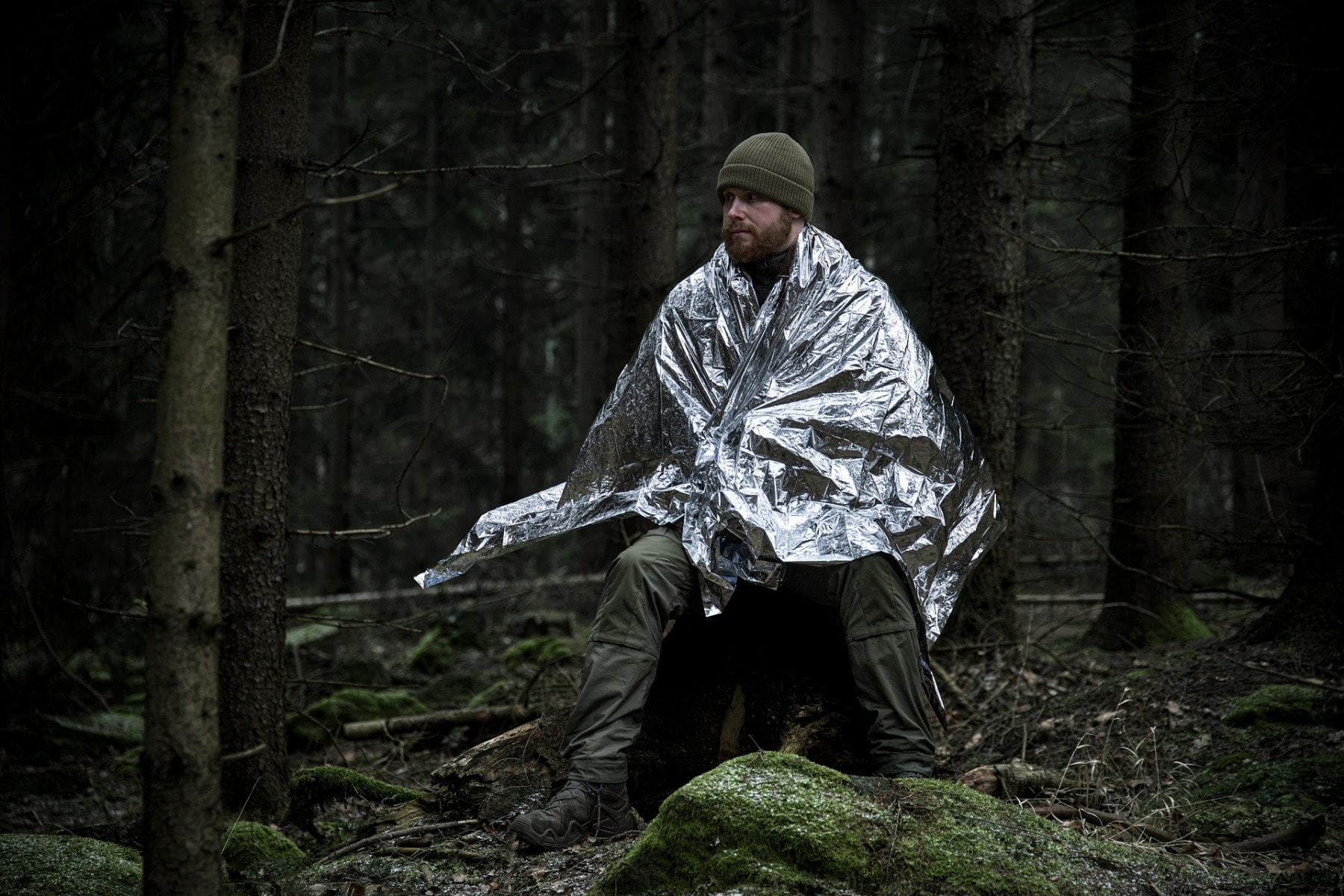
Unfold the blanket and tightly wrap the whole body. The most important thing is to cover the body thoroughly and protect it from the wind. Don't forget the head — a lot of heat escapes through it as well. Cover it with the blanket or a cap, but always leave the face uncovered so as not to make breathing difficult. If it's windy, secure the edges of the blanket to keep the foil from opening.
5. Monitor the casualty's condition
Until rescuers arrive, regularly check whether the casualty:
- is breathing properly,
- is conscious,
- responds to questions or commands.
If they are conscious, have no nausea or abdominal injuries and can swallow safely, you can give them a warm (not hot), sweet drink.
Uses of a thermal blanket — not just rescue operations
An emergency blanket (NRC foil) is associated mainly with first aid, but its uses go much further. Thanks to its low weight and compact size, it's worth having one with you at all times — in the car, first aid kit or backpack.
Mountains, trail, expedition — when the weather writes the script
In the mountains, conditions can change within minutes. An injury on a ridge, a cloudburst, fog, a temperature drop after sunset — in each of these situations an insulating blanket gives you a chance to wait for help in a bearable state. Mountain rescue teams include foil in their standard kit for a reason: it's the lightest item in a backpack that can genuinely save lives.
Bug-out bag (BOB) and EDC
In an evacuation kit, an emergency blanket serves several functions at once: protection from wind and rain, insulation from wet ground, a component of a makeshift shelter strung between trees, and even a heat reflector by the campfire (hung behind your back, it reflects heat back toward you and noticeably increases the perceived temperature). Two to three sheets of foil in a BOB is standard — one might tear, another will remain, the third will serve as a tarp.
Endurance sports
It's hard to imagine the finish line of a marathon, triathlon or mountain race without the silver silhouettes of athletes wrapped in blankets. After heavy exertion the body rapidly loses heat — muscles stop working, the skin is sweaty, and core temperature can drop within minutes. NRC foil stops this process and lets you recover calmly before the athlete changes into dry clothes.
Other practical uses of NRC foil
NRC foil is useful not only in first aid or during sporting events. You can take it with you to a festival, concert or any other outdoor event, where it can help protect you both from hypothermia and from overheating. On hot days it also has a very simple, everyday use — you can use it to reflect sunlight away from windows so that rooms heat up less. In survival situations it can also be used to collect rainwater, create a signalling surface, or improvise a windbreak.
Thermal blanket — frequently asked questions
Does a thermal blanket actually work?
Yes — but not by generating heat. A thermal blanket (space blanket) works by reflecting up to 90% of the radiant heat your body is already producing, keeping it from escaping. It also acts as a windproof and moisture-resistant barrier. The key is correct use: insulate from the cold ground first, then wrap tightly around the whole body. Without ground insulation, a significant amount of heat is still lost through conduction.
Space blanket — which side faces the body, silver or gold?
For both two-tone (silver/gold) models, the difference in insulating performance between orientations is minimal in practice. Both sides reflect thermal radiation. The popular rule "silver in = warm, gold in = cool" is an oversimplification. What matters most is wrapping the body tightly with no gaps for draughts. If in doubt, check the manufacturer's instructions for your specific model.
How long does a thermal blanket keep you warm?
As long as the foil remains intact and stays tightly wrapped around the body. Standard single-use models are designed for one-off emergency use — after being unfolded and refolded they may lose integrity. Heavier-duty reusable models last longer and can be packed away and used again. MILITARY stocks both types in its range of emergency blankets.
What's the difference between a thermal blanket, space blanket, emergency blanket and survival blanket?
They are all the same product under different names. "Space blanket" refers to the NASA origins of the technology; "thermal blanket" and "emergency blanket" describe its function; "survival blanket" is common in outdoor and prepping communities; "NRC foil" (National Research Council) is the technical designation. In the UK, it is also known as a foil blanket. Car first aid kits compliant with DIN 13164 are required to include one.
Can you use an emergency blanket to keep cool in hot weather?
Yes. With the reflective side facing outward, the foil deflects incoming solar radiation rather than retaining body heat. In heat, do not wrap the blanket tightly around the body — instead suspend it overhead as a shade canopy or hold it between yourself and the sun source. On hot days, a thermal blanket taped to a window (reflective side out) can also noticeably reduce indoor temperature by reflecting sunlight before it enters the room.
Can you reuse an emergency blanket?
Standard single-use foil blankets (the thin Mylar type found in most first aid kits) are not designed to be refolded and reused reliably — once unfolded they are prone to tearing and may not seal properly again. Heavier reusable models are thicker, more tear-resistant and can be carefully folded and packed away after use. If a blanket has been used in a life-threatening situation, replace it regardless of apparent condition.
Summary — emergency blanket
At MILITARY you'll find both classic single-use NRC emergency blankets and more durable reusable versions designed for bug-out bags and first aid kits. Whichever model you choose, the principle is the same: insulate from the ground first, wrap tightly, cover the head, leave the face clear.
If you are building a first aid kit, putting together a BOB or preparing for a longer trip, it's also worth checking our categories with first aid kits, survival gear and tactical backpacks. A thermal blanket is only a starting point — a real advantage in a crisis comes from a complete, well‑thought‑out kit.