Česká republika
  Deutschland
  Austria
  United Kingdom
  Suomi
Suomi  France
  Magyarország
  Italia
  Polska
  România
  Україна
  Europe
How to Choose Binoculars – A Complete Buying Guide

Choosing binoculars doesn't have to be complicated. To start, it's enough to answer two questions: what will you use them for, and how often do you plan to carry them. Someone looking for lightweight binoculars for the mountains needs a different model than a person who does long wildlife observations.
When choosing binoculars, the three most important basic parameters are: magnification, objective lens diameter and field of view. These largely determine what you will see, how big the binoculars will be, and in what conditions they will work best.
Quick summary
- 8x42 is the all-round winner: wide field of view, bright image, steady from the hand — best for bird watching, hiking and general outdoor use.
- 10x42 for more detail at distance — great for wildlife watching and hunting, but narrower field of view and more sensitive to hand shake.
- Best compact binoculars for travel: 8x25 or 10x25 — pocketable, light, always to hand.
- From 12x magnification upward, a tripod or image-stabilised model becomes necessary.
- For outdoor and wet conditions: IPX7 waterproofing, nitrogen/argon fill, BaK4 prisms and FMC coatings are essential.
- Spectacle wearers: check the eye relief figure — at least 14–15 mm and twist-up or fold-down eyecups.


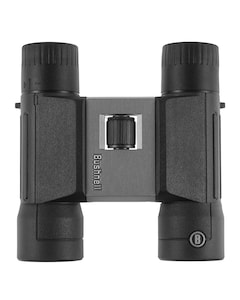
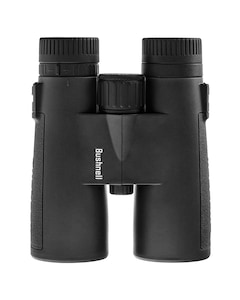
What do binocular parameters mean?
Usually every pair of binoculars has a marking on the body made up of two numbers, e.g. 8x42 or 10x50. They contain three key pieces of information about the equipment: magnification, objective lens size, and the resulting image brightness. Before we move on to applications, it's worth understanding these parameters properly.
Magnification
The first number in the binoculars' marking is the magnification factor – it shows how many times the binoculars bring the observed object closer. 8x binoculars make an object 800 yards away appear as if it were 100 yards from you. With a 10x model, an object 1000 yards away looks as if it were 100 yards from the observer.
Although higher magnification may seem like a better choice, in practice it also means a narrower field of view, greater sensitivity to hand shake, and a less stable image.
Without a tripod, 8x is the optimal choice for most users, while a more experienced observer may opt for 10x. 12x and higher models work best with a tripod or with image stabilisation (IS).
Objective lens diameter
The second number in the binoculars' marking is the objective lens diameter expressed in millimeters. The larger it is, the more light enters the optical system, which translates into a brighter image, especially in low light.
The exit pupil depends on the objective diameter and magnification. It is calculated by dividing the objective diameter by the magnification. For example, 8x42 binoculars have a 5.25 mm exit pupil, while 10x25 – only 2.5 mm.
The larger the exit pupil, the better the binoculars perform in low light. Approximate values for different conditions:
- Daytime: 3–4 mm
- Forest, overcast, dusk: 5–6 mm
- Night and astronomy: 6–7 mm
With age, the human pupil usually dilates less, so the benefits of a very large objective lens diameter may be smaller. For example, for an older user, lighter 10x50 binoculars may turn out to be more practical than 10x56, if the extra brightness of the larger model cannot be fully used by the eye.
Field of view
The field of view tells you how wide a section of terrain you will see through the binoculars. It is most often given in feet at a distance of 1000 yards.
A wide field of view makes it easier to observe moving animals, track a target, and quickly scan the terrain. It is particularly useful for wildlife observation and in outdoor applications. When comparing two models with similar parameters, it's therefore worth looking not only at magnification, but also at the field of view.
How to choose binoculars for your use case
Knowing the parameters is half the battle – the other half is matching the equipment to where and how you'll be using it. Below you'll find specific recommendations for the most common applications.
Best compact binoculars for hiking and travel
For tourists and trekkers the most important factors are low weight, compact size and resistance to weather conditions. The best compact binoculars for hiking — such as an 8x25, 10x25 or 8x32 — take up very little space and fit in a jacket pocket or belt pouch. For short trips and as a just-in-case pair, a compact model is always the right call. If you want one pair that handles both hiking and occasional wildlife watching, an 8x32 is the best all-round compact choice.

Best binoculars for bird watching
For bird watching, the 8x42 is the long-established standard: a wide field of view makes it easy to find and follow birds, especially in woodland or when a flock is moving. The bright image is comfortable from the hand over long sessions. If you regularly watch birds at longer distances and fine detail matters more than ease of tracking, the 10x42 is the birder's second choice. For birds at close range, look for a short minimum focus distance — under 2 m (6.5 ft) is ideal. The best binoculars for bird watching also have FMC coatings for true colour rendering.

For tactical and field use
For tactical and field use, 8x42 or 10x42 binoculars will work best. 8x provides a wider field of view and faster terrain scanning, while 10x makes it easier to observe distant objects.
It's worth choosing a model with IPX7 waterproofing, nitrogen filling, a rubberized housing and fast focusing. A 1/4" tripod socket will also be useful. A minimum focus distance of 2–3 m increases versatility. More advanced models can feature an integrated laser rangefinder.

For concerts and events
For concerts, opera and sporting events, light and compact binoculars work best. Models 8x25 or 10x25, weighing about 9–12 oz, are a good choice. If you're looking for a more versatile model, it's worth choosing 8x32 – it's still light, but provides a brighter image and will also work well for nature observation.

What else to look for when choosing binoculars
Optical parameters are the foundation, but comfort of use is often determined by features that are easy to overlook when you first compare models.
Weight and size
If the binoculars are going to stay in your backpack most of the time, a difference of a few hundred grams can be noticeable.
For tourism and everyday carry it's best to choose compact or medium-sized models. A larger binocular makes sense when observational capability is more important than mobility.
It's also worth paying attention to the possibility of folding the binoculars and the way they are carried – a neck strap, case or the option of using a harness can significantly improve comfort during long observation sessions.
Waterproofing and resistance to field conditions
For outdoor use you should primarily look at water resistance and gas filling. An IPX6–IPX7 rating provides protection against heavy rain and brief submersion, while nitrogen or argon prevents the optics from fogging up from the inside.
BaK4 prisms are also important, as they ensure good image quality, and FMC (Fully Multi-Coated) coatings improve light transmission, contrast and colour reproduction.
Adjustment comfort
The mechanics of the binoculars have a major impact on user comfort. The focus wheel should operate smoothly, without play and with the right amount of resistance, and the diopter adjustment should have a lock or sufficient resistance so the setting does not change.
It's worth choosing a model with adjustable eyecups, which allow you to set the distance between the eye and the eyepiece for both people with glasses and without. Ideally, they should be made of a soft material. Spectacle wearers should check that the eye relief figure is at least 14–15 mm.
Binoculars buying guide — frequently asked questions
What does 8x42 mean on binoculars?
The first number (8) is the magnification — objects appear 8 times closer than to the naked eye. The second number (42) is the diameter of the objective lenses in millimetres. From these two you can calculate the exit pupil: 42 ÷ 8 = 5.25 mm. The larger the exit pupil, the brighter the image in low light. 8x42 is widely regarded as the most versatile specification for general outdoor use and bird watching.
What are the best binoculars for bird watching?
The 8x42 is the standard recommendation for bird watching: a wide field of view makes it easy to locate and follow birds, the bright image is comfortable for long sessions, and the 5.25 mm exit pupil handles low light well. For more detail on distant subjects, the 10x42 is the experienced birder's choice. Look for a short minimum focus distance (under 2 m / 6.5 ft) and FMC coatings for accurate colour. The best binoculars for bird watching in the UK usually balance optics, weight and waterproofing.
What are the best compact binoculars for hiking?
For hiking, the best compact binoculars are models in the 8x25, 10x25 or 8x32 range — light enough to carry all day, small enough to slip into a pocket. If you want one pair that doubles for wildlife watching, the 8x32 is the most versatile compact option: still light, but with a noticeably brighter image than 8x25 due to the larger objective. Look for IPX6 waterproofing as a minimum for mountain use.
What magnification binoculars do I need?
For most handheld use without a tripod, 8x is the best all-round choice: stable image, wide field of view, easy to use. 10x brings more distant detail closer but is more sensitive to hand shake and gives a narrower field. From 12x upward you really need a tripod or image-stabilised binoculars — the shake becomes too noticeable to observe comfortably. For safari, birding and general outdoors: start with 8x42 and go to 10x42 only if you regularly need greater reach.
What binoculars are best for a safari?
For safari, an 8x42 or 10x42 is ideal: the wider field of 8x helps when you're sweeping the horizon or following fast-moving animals, while 10x gives more detail at the longer distances common on open plains. Waterproofing and dustproofing (IPX7) are essential. A roof prism design is more compact than a Porro prism for packing. A model with a close focus of 2–3 m is a bonus for smaller wildlife at camp.
What binoculars are best for spectacle wearers?
Spectacle wearers should prioritise eye relief — the distance between the eyepiece and your eye at which you can see the full field. Aim for at least 14–15 mm. Choose a model with twist-up or fold-down rubber eyecups that can be adjusted quickly whether you're wearing glasses or not. A field of view over 60° (apparent) reduces the tunnel-vision effect that can occur with insufficient eye relief.
Binoculars in the MILITARY range
In the binoculars section at MILITARY you'll find a wide selection of optical equipment tailored to different applications and budgets – from compact travel and pocket models, through rugged field binoculars, up to tactical models with a rangefinder and reinforced housing.
If you're unsure which model to choose or want to compare specific models, use the filters on the category page or contact our advisors. We'll be happy to help you choose binoculars that match your needs and budget.