 Česká republika
  Deutschland
  Austria
  United Kingdom
  Suomi
Suomi  France
  Magyarország
  Italia
  Polska
  România
  Україна
  Europe
How to use a compass? A guide for beginners and more
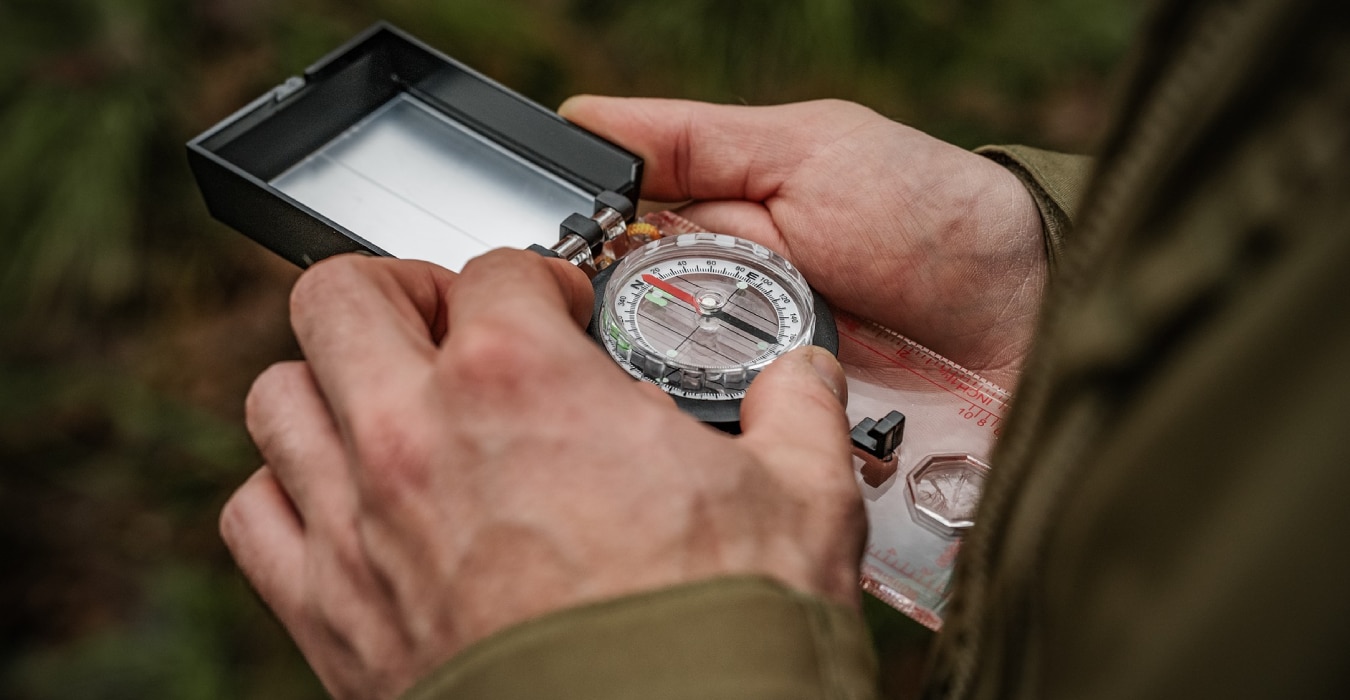
A compass remains one of the most reliable tools for navigation in the field. Unlike a GPS device or a smartphone, it requires no power, works in virtually any conditions, and allows you to find your direction of travel even during electronic failure or when you are beyond mobile signal coverage. For these reasons, it is standard kit for hikers, fell runners, orienteers, bushcrafters, and military users alike.
To use a compass correctly, however, you need to understand how it works, what the red needle means, and how to take a bearing and use one alongside a map. This guide explains step by step how to use a compass for field navigation — from reading the cardinal points to working with a map and determining an azimuth.
How does a compass work — and what does the red needle mean?
A compass is a navigation instrument that uses the Earth's magnetic field to determine direction. Its most important component is the magnetic needle, which rotates freely inside a liquid-dampened capsule.
The red end of the compass needle always points to magnetic north. When you use a compass, you set it so that the red needle aligns with the "N" marking on the rotating bezel. Once this is done, all other directions can be read correctly from the dial.
A compass points to magnetic north, not true (geographic) north. The difference between them is called magnetic declination. In Great Britain, the current declination is small (approximately 1–3° west depending on location and year) and for most hillwalking and trekking purposes can be ignored. For precision navigation, check the current declination for your area — Ordnance Survey maps include declination information in their legend.
Compass readings can also be disrupted by nearby metal objects, electronics, magnets, and overhead power cables. For a reliable reading, hold the compass horizontally and keep it away from your phone, multitool, belt buckle, and other metallic items in your kit.
It is also worth noting that a compass and a prismatic (lensatic) compass are not exactly the same instrument. More detail: Prismatic compass vs. compass — what distinguishes these two navigation instruments?

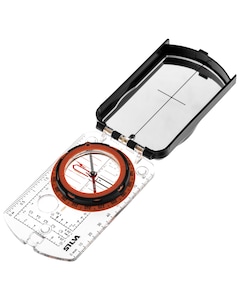
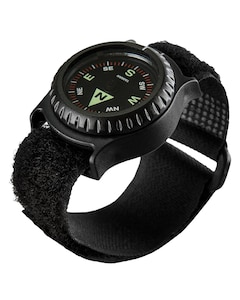
How to read a compass — parts and what they do
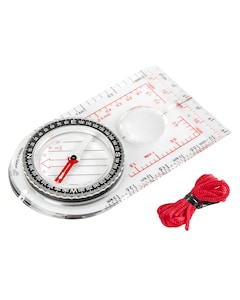
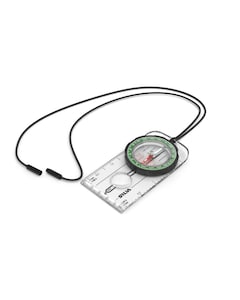
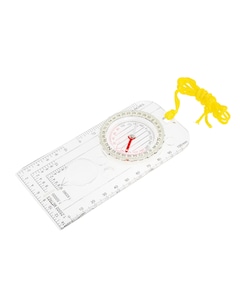
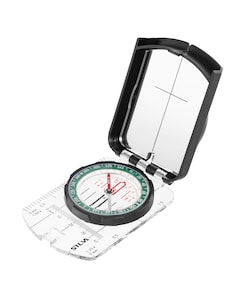
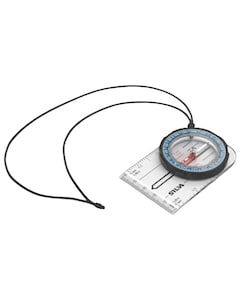
A basic compass lets you find the cardinal points and maintain a direction of travel. A more advanced orienteering compass (also called a baseplate or map compass) also lets you work with a map, take precise bearings, and plan routes. The diagram below shows a typical map compass with its key components:
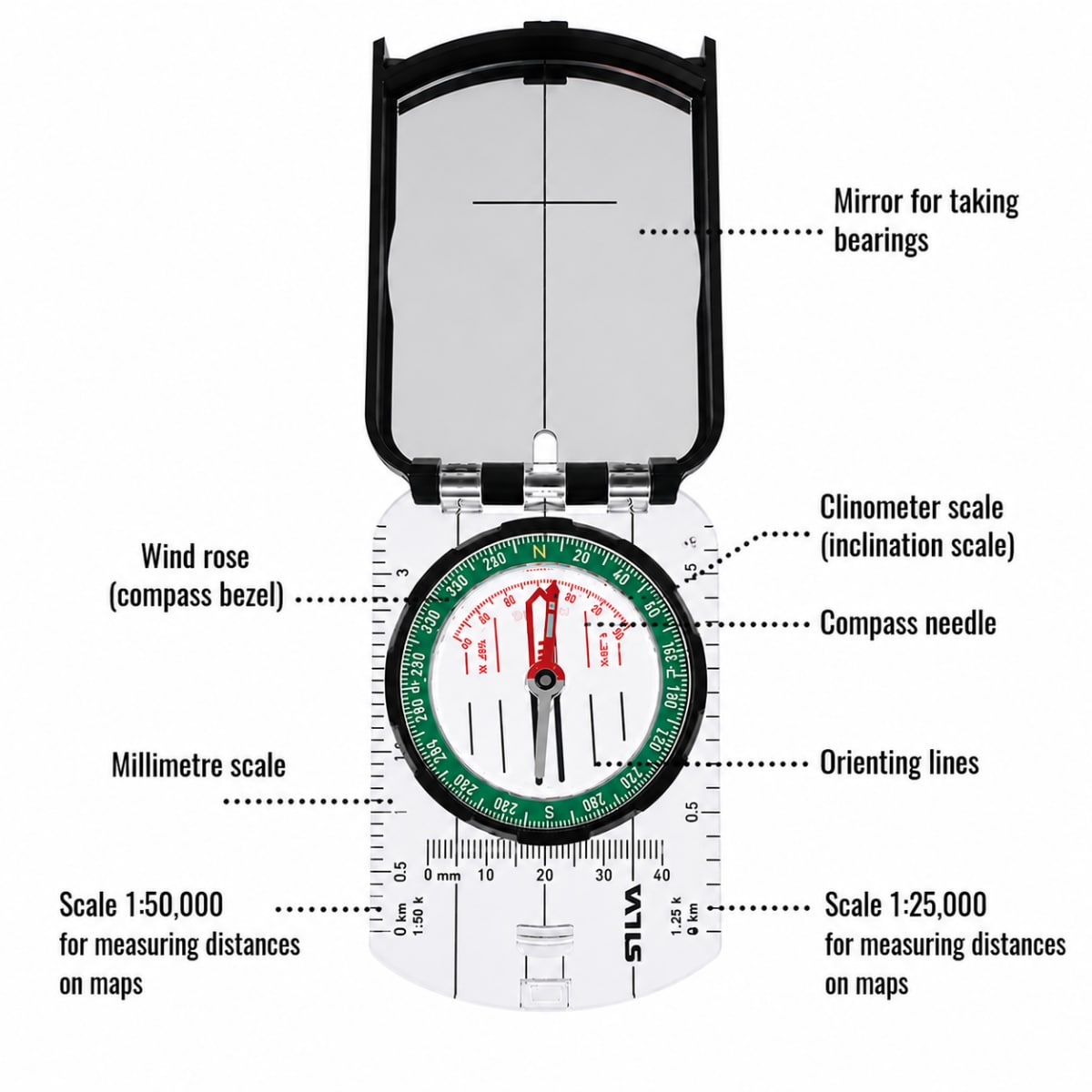
| Component | What it does |
|---|---|
| Magnetic needle | Rotates freely inside the capsule. The red end always points to magnetic north. |
| Rotating bezel (degree scale) | Marked 0–360°, used to read direction and set a bearing. |
| Sighting mirror | On some models — allows precise sighting of a landmark and accurate bearing reading while the compass is held at eye level. |
| Declination scale | Allows adjustment for the difference between magnetic north and true north when precision is required. |
| Millimetre ruler and map scales | Used to measure distances on a map — typically scaled for 1:25,000 (OS Explorer) and 1:50,000 (OS Landranger) maps. |
| Direction of travel arrow | The arrow on the baseplate that shows the direction you intend to travel — not to be confused with the magnetic needle. |
| Orienting lines | Lines inside the bezel used to align the compass with the map's north lines (grid north on OS maps). |
For basic field orientation, a simple compass and an understanding of the cardinal points are sufficient. If you plan to work with an Ordnance Survey map, determine bearings, and navigate a route across the hills, an orienteering baseplate compass with a degree scale, ruler, and map scales will be considerably more useful.
How to use a compass — finding the cardinal points
To use a compass correctly, one fundamental principle applies: the red end of the needle always points to magnetic north. All other directions are read relative to this.
Step 1 — hold the compass horizontally
Place the compass flat on your open palm. This is important because the magnetic needle must rotate freely without touching the inside of the capsule. Keep the compass away from your phone, penknife, keys, or any other metallic items in your kit — they can pull the needle off course.
Step 2 — wait for the needle to settle
After a few seconds, the needle will stop moving. The red end will point to magnetic north. The bezel is marked with the four cardinal points:
- N — north
- E — east
- S — south
- W — west
Step 3 — align the needle with north on the bezel
Turn your body (or just the compass) until the red end of the needle aligns with the N marking on the rotating bezel. This is the critical step. Once the needle sits correctly on N, the entire compass is oriented and all the cardinal points on the dial correspond to the actual directions around you.
Step 4 — read your direction
With the compass correctly aligned, you can read:
- what lies in front of you
- where east and west are
- which direction you are currently facing
The degree scale runs around the bezel:
- 0° / 360° — north
- 90° — east
- 180° — south
- 270° — west
For example: if you are facing east, the direction of travel arrow will read approximately 90°. If you turn to face south, it will read approximately 180°. This is how compass navigation allows you to determine and maintain a direction of travel without GPS or a phone signal — essential on the fells in poor visibility or in dense woodland.
How to use a compass with a map
A compass alone tells you your direction. Combining a compass with a map — particularly an Ordnance Survey 1:25,000 Explorer or 1:50,000 Landranger sheet — allows you to navigate precisely in the field: locate your position, plan a route, and follow it accurately even without any phone signal.
Setting the map to the ground
The first step is to orient the map so that features on the map correspond to what you can see around you in the terrain.
- Lay the map on a flat surface.
- Place the compass on the map.
- Rotate the map (with the compass on it) until the red needle aligns with north as marked on the map. On OS maps, grid north (shown by vertical grid lines) is very close to magnetic north — for practical hillwalking purposes they can be treated as the same.
- Once the map's north matches the compass needle, the map is correctly set to the ground.
From here, roads, footpaths, walls, hills, and other features on the map should correspond directly to what you see around you.
Locating your position by triangulation
If you are unsure of your exact position, you can locate yourself using visible landmarks in the terrain — a technique called triangulation or resection.
- Identify two well-visible landmarks around you: a summit, a building, a mast, a road junction, or a prominent ridge feature.
- Take a bearing to each landmark with the compass.
- Transfer those bearings as lines on the map.
Where the two lines cross is approximately your position. This is one of the fundamental techniques in map and compass navigation and is worth practising before you need it in poor conditions.
Taking a bearing from the map and following it on the ground
A baseplate compass lets you transfer a direction directly from the map to the ground — the core skill in compass navigation.
- Place the long edge of the baseplate on the map, connecting your current position with your target destination.
- Rotate the bezel until the orienting lines inside it run parallel to the map's north–south grid lines, with the N marker pointing to the top of the map.
- Lift the compass off the map and turn your whole body until the red needle sits within the orienting arrow (the "red in the shed" position).
- The direction of travel arrow now points the way you need to walk.
In practice, pick a distinctive landmark on that bearing — a boulder, a fence post, a tree on the skyline — and walk to it, then take another bearing to confirm your position before moving on.
Measuring distance on the map
Most orienteering compasses include a millimetre ruler and map scales for 1:25,000 and 1:50,000 — the two standard Ordnance Survey scales used across England, Scotland, and Wales. Use these to measure the distance between two points on the map before setting off, so you have a realistic sense of how far you need to travel and how long it will take.
How to take a bearing and navigate by azimuth
An azimuth (or bearing) is the angle between north and your chosen direction of travel, expressed in degrees from 0° to 360°. Navigating by azimuth allows you to maintain a precise direction across open ground, dense woodland, or in poor visibility — situations common on Dartmoor, in the Cairngorms, and across the Lake District fells.
Step 1 — identify your target
Find the point you want to reach. It might be:
- a summit or trig point
- a road junction or gate
- a building or mast visible on the map
- a specific grid reference on your OS sheet
Step 2 — set and read the bearing
Point the direction of travel arrow at your target (or take the bearing from the map as described above). Rotate the bezel until the red needle aligns with the N marking. Read the bearing at the index line on the baseplate — that number in degrees is your marching azimuth. For example:
- 90° — travel east
- 180° — travel south
- 315° — travel north-west
Step 3 — maintain the bearing
As you walk, periodically check that the red needle still aligns with the N marking on the bezel. As long as it does, you are walking on your set bearing. Do this whenever you stop to look around, cross a feature, or suspect you have drifted off course.
Using intermediate landmarks
Walking with your nose in the compass the whole time is slow and inefficient. Instead:
- Set the bearing.
- Look along the direction of travel arrow.
- Identify a visible landmark on that bearing — a distinctive tree, a rock, a break in a wall.
- Walk to that landmark.
- Check the bearing again and pick the next landmark.
This technique — sometimes called "aiming off" combined with waypoints — lets you navigate quickly and accurately across difficult terrain.
Common compass errors and how to avoid them
Holding the compass near metal objects
The magnetic needle responds to nearby metal and magnetic fields. A multitool, belt buckle, watch, a metal hipbelt buckle, or the frame of your rucksack can all deflect the needle. When taking a reading, move the compass away from your equipment and hold it away from your body.
Confusing the magnetic needle with the direction of travel arrow
A baseplate compass has two different arrows:
- the magnetic needle (red end always points to magnetic north),
- the direction of travel arrow (fixed on the baseplate, showing where you intend to walk).
Confusing them is one of the most common errors among beginners and can send you walking in exactly the wrong direction. Always check that it is the red end of the needle that is aligned with N on the bezel, not the white end — which would put you 180° off course.
Reading the bearing before the needle has settled
After moving or changing the compass orientation, allow a few seconds for the needle to stabilise in the liquid capsule before reading the bearing. Reading too quickly — especially in cold weather when liquid-dampened compasses slow slightly — can give an inaccurate result.
Using the compass near power lines, pylons, and vehicles
High-voltage power lines, railway tracks, cars, and large metal structures all create local magnetic interference. In these situations, move well away from the source before taking a bearing. In remote British countryside this is rarely an issue on the open fell, but it is worth bearing in mind near roads, pylons, and buildings.
Which compass to choose?
Baseplate (orienteering) compass
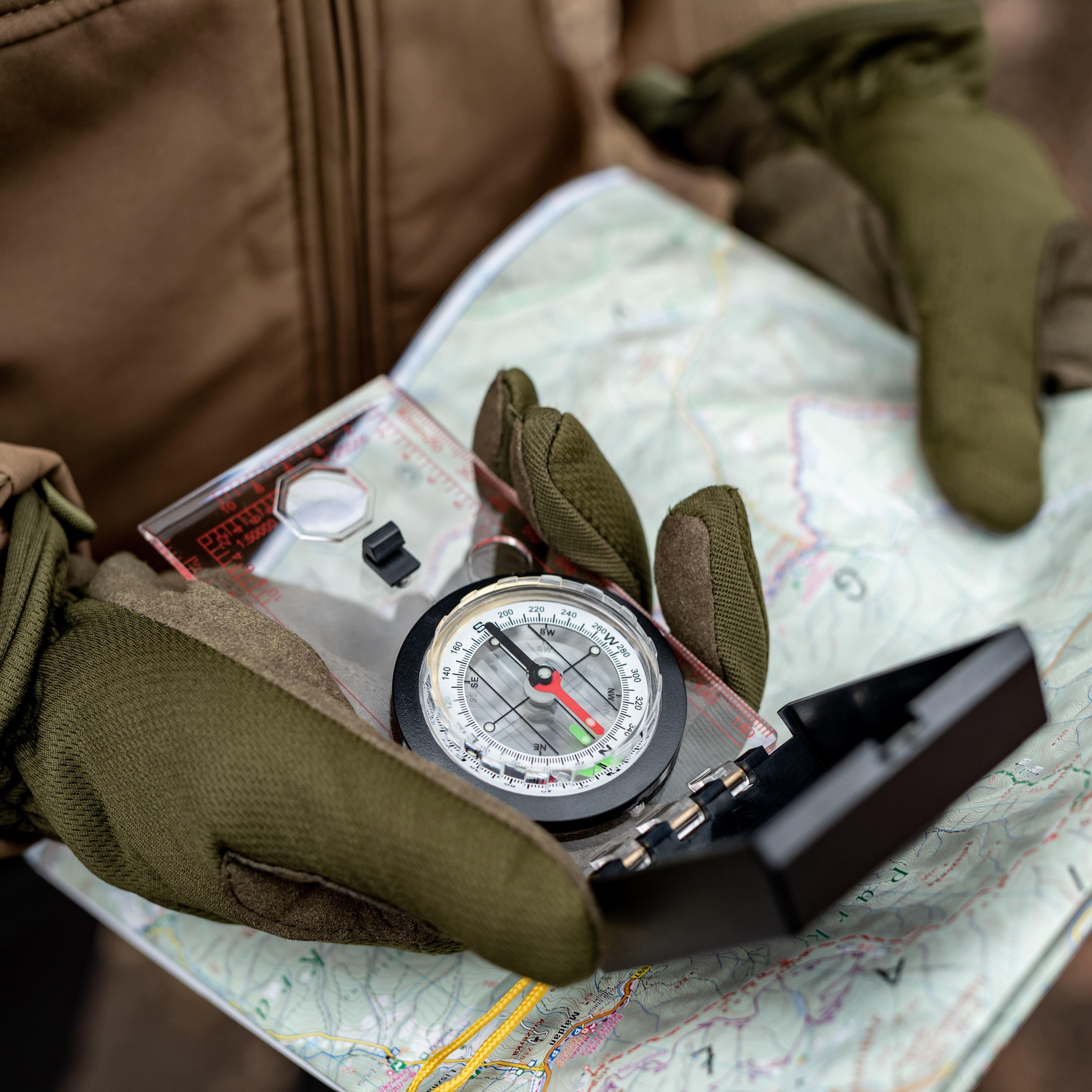
The best starting point for most beginners and the standard choice for hiking, trekking, orienteering, and map work in the UK. A clear plastic baseplate, a millimetre ruler scaled for OS maps, and a rotating bezel make it straightforward to take bearings from a map and follow them on the ground. Lightweight and quick to use — well suited to hillwalking in the Lake District, Brecon Beacons, or the Cairngorms.
Prismatic (lensatic) compass
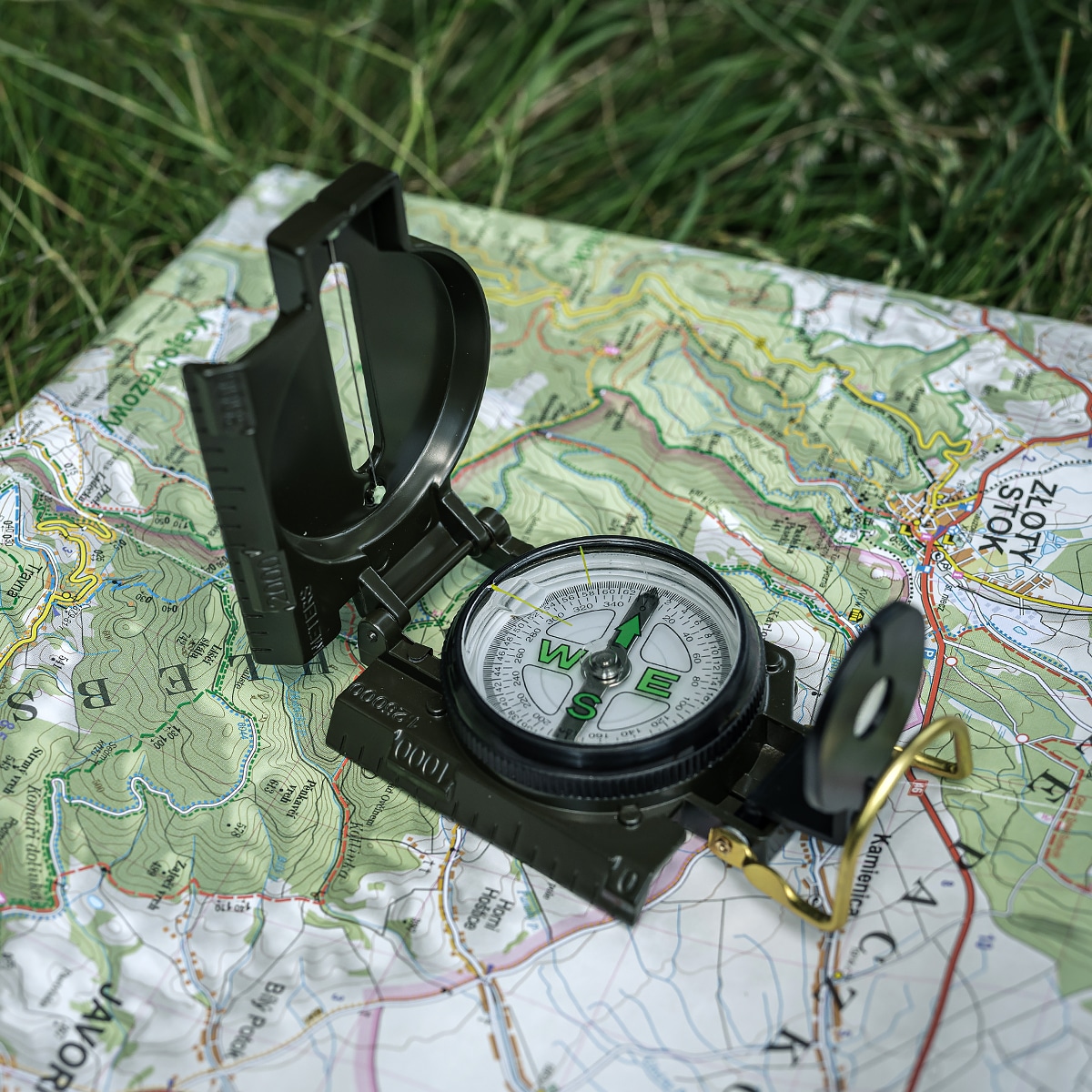
A prismatic or lensatic compass is the better choice for survival, bushcraft, and demanding field navigation. Its sturdier construction, foldable casing, and sighting system allow for more precise bearings in difficult conditions. This type is widely used in military applications and is a popular choice for serious wilderness navigation and long expeditions.
Button or keyring compass
These are the smallest compass models, intended primarily as emergency kit or part of an EDC setup. They can indicate basic cardinal points quickly, but their small size and limited accuracy make them unsuitable for serious map work or navigation in poor visibility. Carry one as a backup, not as a primary navigation tool.
What to look for when buying a compass
A good compass for UK use should have:
- a clear 0–360° degree scale on the rotating bezel,
- a stable, liquid-dampened needle that settles quickly,
- luminous markings for low-light use,
- a durable, impact-resistant casing,
- a rotating bezel for setting bearings,
- a baseplate ruler scaled for 1:25,000 and 1:50,000 OS maps (for hillwalking use).
Compass navigation — key points
The ability to use a compass is one of the most reliable and transferable navigation skills you can develop. Even a simple model allows you to determine your cardinal points, set a bearing, and maintain a direction of travel without GPS or a phone — a significant safety advantage when visibility drops on the hills, the battery dies, or you venture beyond mobile coverage.
For most hillwalking and trekking in the UK, a quality baseplate orienteering compass used alongside an OS 1:25,000 Explorer map is all that is needed. For survival, bushcraft, and more demanding navigation, a sturdier prismatic compass with a sighting system gives greater precision. Whatever the model, the most important investment is time spent practising in the field — taking bearings, orienting the map, and navigating by azimuth in conditions where it does not matter if you make a mistake.
At MILITARY, you will find both beginner-friendly orienteering compasses and more advanced models for survival, outdoor, and military use — making it straightforward to choose the right tool for the kind of navigation you plan to do.