Česká republika
  Deutschland
  Österreich
  United Kingdom
  Suomi
Suomi  France
  Magyarország
  Italia
  Polska
  România
  Україна
  Europe
Which telescope should a beginner choose? A complete guide
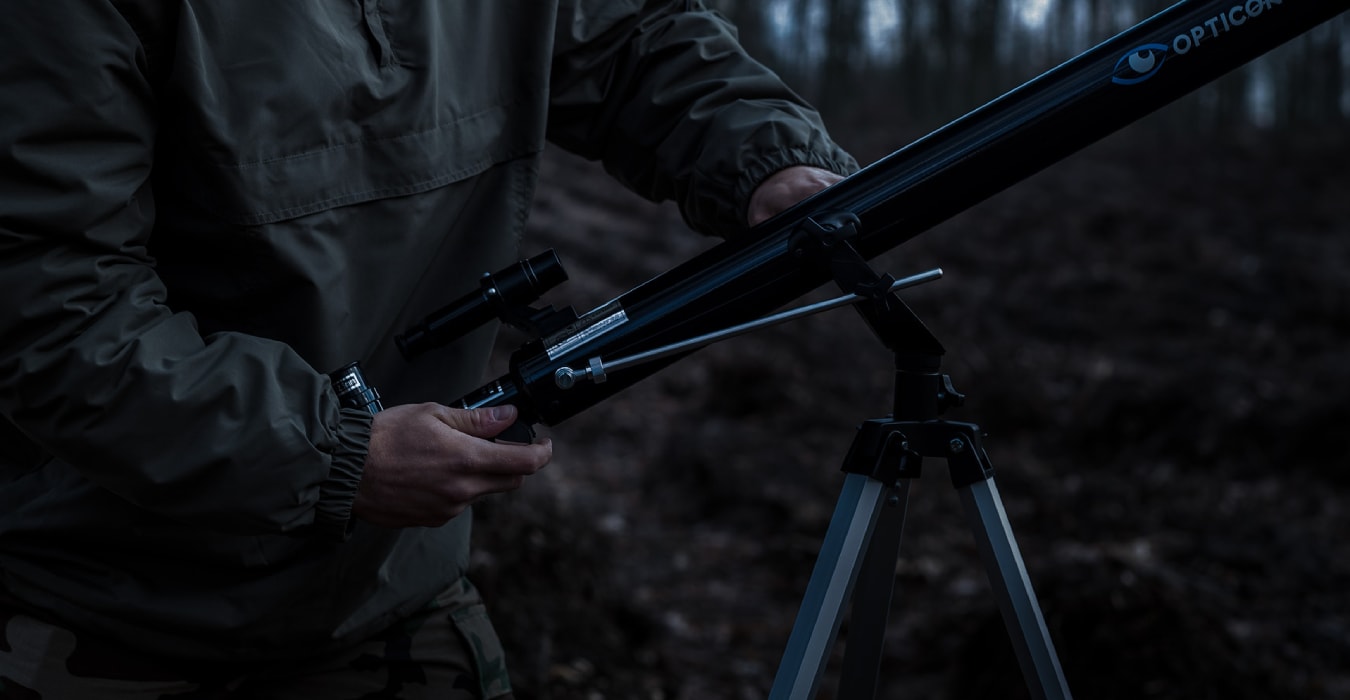
The moment you first see Saturn's rings or the craters of the Moon through a telescope is one that tends to stay with you. For most people, it is also the moment they want to see more — and that is when the question of choosing equipment becomes important. Faced with dozens of models, unfamiliar construction types, and specifications that don't immediately make sense, beginners often feel overwhelmed before they have even looked through an eyepiece.
This guide explains which telescope for beginners to choose, how the most popular designs differ, and which specifications actually matter before you spend any money. Whether you are buying for yourself, for a child, or looking for the best beginner telescope in the UK, this is where to start.
Is a telescope actually the best place to start?
For many people, a telescope seems like the obvious first purchase for astronomy — but it may not be the right one in every situation. If you are new to stargazing, live in a light-polluted town or city, have a limited budget, or are buying for a child, it is worth considering astronomical binoculars first.
Good astronomical binoculars allow you to start exploring the night sky without the need to set up a mount or learn how to operate a telescope. They are lighter, more portable, and ready to use in seconds — from a garden, a dark lay-by, or a hillside in the Peak District.
Even a modest pair of 10×50 binoculars will show you the craters of the Moon, brighter star clusters such as the Pleiades and the Hyades, the Milky Way from a dark site, and even the Andromeda Galaxy (M31) as a faint smudge of light. Jupiter's four largest Galilean moons are visible too. For many people, a few months with good binoculars is the most effective way to discover whether astronomy will genuinely become a regular hobby before investing in a larger and more demanding telescope.
Types of beginner telescope — how do they differ?
When choosing your first astronomy telescope, you will typically have to decide between two main optical designs: a refractor and a reflector. Both differ in construction, how they handle light, and what they are best suited for. This decision has a significant effect on observation comfort and on what you can realistically see.
Refracting telescope (refractor)
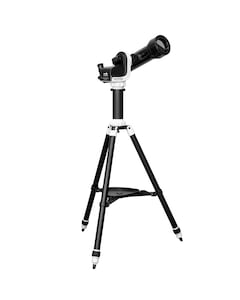
A refractor telescope uses a system of lenses to focus light and form an image. It is the simplest design to operate and the one most commonly recommended for beginners.
Advantages of a refractor:
- no need for optical collimation (alignment) — set it up and observe,
- high-contrast, sharp images of the Moon and planets,
- works well from gardens, balconies, and light-polluted locations,
- quick to set up and easy to transport.
Disadvantages of a refractor:
- higher cost per millimetre of aperture compared to reflectors,
- less capable for observing faint deep-sky objects.
Best for: beginners, children, and anyone observing the sky mainly from urban or suburban locations in the UK — where light pollution limits what you can see anyway, and the sharpness of a refractor on the Moon and planets is a clear advantage.




Reflecting telescope (reflector)
A reflector telescope uses a system of mirrors to gather and focus light. This design makes it possible to offer a much larger aperture for the same price as a smaller refractor.
Advantages of a reflector:
- significantly larger aperture for a given budget,
- excellent for observing nebulae, galaxies, and faint star clusters from a dark sky,
- outstanding value for money at larger apertures.
Disadvantages of a reflector:
- requires periodic collimation (realigning the mirrors) — essential but learnable,
- larger and heavier than a refractor of comparable cost,
- less suited to observing from a light-polluted back garden.
Best for: those planning to observe regularly from darker skies — a rural location, a National Dark Sky Park such as Exmoor or Galloway Forest, or a dark-sky site — and who want to develop the hobby seriously over time.
Key telescope specifications — what actually matters?
When browsing telescopes, many beginners focus on the magnification figure printed on the box. In practice, magnification is one of the least useful numbers to consider. The specifications that actually determine what you will see are quite different.
Aperture — the most important specification
Aperture is the diameter of the telescope's lens or mirror, usually given in millimetres. The larger the aperture, the more light the telescope gathers, and the brighter and more detailed the image becomes. Aperture, not magnification, is the single most important factor in a telescope's capability.
- Up to 70 mm — basic views of the Moon, the brightest planets, and larger star clusters. A good starting point for absolute beginners and young children.
- 80–110 mm — clearer planetary detail, Saturn's rings well defined, Venus phases, Jupiter's cloud bands, and brighter nebulae within reach.
- 150 mm and above — genuine deep-sky capability; galaxies, globular clusters, and fainter nebulae become accessible from a dark site.
For most beginners in the UK, a telescope with an aperture of around 80–130 mm offers the most versatile combination of capability, portability, and price.
Focal length and magnification — a common myth
A telescope does not have a fixed magnification — the magnification depends on which eyepiece you use. The formula is simple:
Magnification = Telescope focal length ÷ Eyepiece focal length
For example, a telescope with a 1,000 mm focal length paired with a 10 mm eyepiece gives 100× magnification. Swap to a 25 mm eyepiece and the magnification drops to 40× — but the image will be brighter, steadier, and easier to use. Higher magnification does not mean a better view. At too high a magnification for the available aperture, images become dim, blurry, and extremely sensitive to any vibration or atmospheric turbulence. A good beginner telescope should be chosen first for aperture and optical quality, with magnification as a secondary consideration.
Mount — altazimuth or equatorial?
The mount determines how the telescope moves and tracks objects as they drift across the sky.
- An altazimuth mount moves the telescope up-down and left-right — intuitive, like a camera tripod. It is the simplest and most suitable choice for most beginners. Objects drift out of the eyepiece view as the Earth rotates, but at low to moderate magnifications this is easy to manage.
- An equatorial mount is aligned with the Earth's rotational axis and makes it much easier to track objects continuously with a single slow-motion control. It is more useful for extended observations and for astrophotography, but requires correct polar alignment and a steeper learning curve to set up correctly.
It is also worth knowing about the Dobsonian mount — a very simple altazimuth design widely used with larger reflectors. A Dobsonian-mounted reflector gives an excellent aperture-to-price ratio and is considered one of the best platforms for beginners who plan to observe from darker skies outside towns and cities. The design is easy to use, very stable, and allows you to buy a significantly larger mirror for the same budget.

Which telescope for which type of observing?
Before buying, it is worth deciding what you most want to see. The best telescope for Moon and planet viewing is different from the best choice for nebulae and galaxies.
Moon and planet observation (Jupiter, Saturn, Mars)
The Moon and the bright planets are the most popular first targets, and for good reason — they are visible even from a light-polluted city garden and reward you with striking detail. What you can see grows noticeably with aperture:
- 70 mm — Moon craters, Venus phases, Saturn's rings, basic Jupiter detail,
- 80–100 mm — cloud bands on Jupiter, all four Galilean moons, a clearer image of Saturn's Cassini Division and ring shadow, Mars polar caps when the planet is well placed,
- 150 mm+ — finer atmospheric detail on Jupiter, better resolution on Saturn, improved sharpness on the Moon at high magnification.
It is worth being realistic about what you will see: visual planetary observations look nothing like processed images from the Hubble Space Telescope or planetary probes. What you will see is smaller, subtler, and more monochromatic — but the experience of seeing Saturn's rings with your own eyes for the first time is one that nobody forgets.
For Moon and planet observing, a refractor telescope with an 80–100 mm aperture on an altazimuth mount is the practical recommendation for most UK beginners. It needs no collimation, sets up in minutes, and performs excellently from a suburban back garden.
Nebulae, galaxies, and star clusters
Deep-sky objects — nebulae, galaxies, and globular star clusters — require both a larger aperture and a dark sky to show their best. From a typical British suburb, the view of most deep-sky objects is limited by light pollution rather than the telescope itself. From a genuinely dark location, however, the difference a larger aperture makes is dramatic.
For deep-sky observing, reflecting telescopes with at least 150 mm of aperture are the right tool. A Dobsonian-mounted 150 mm or 200 mm reflector is often the first recommendation from UK astronomy clubs for anyone who wants to observe beyond the solar system.
One of the most rewarding early deep-sky targets is the Andromeda Galaxy (M31) — the closest major galaxy to the Milky Way, around 2.5 million light-years away, and visible to the naked eye from a dark British hillside on a clear autumn night. A telescope reveals the galaxy's brighter core and its two smaller satellite galaxies. From a dark-sky site such as Kielder Forest in Northumberland, the Yorkshire Dales, or the Brecon Beacons, it is a genuinely impressive sight.
If your priority is observing star clusters, galaxies, and nebulae, a Dobsonian reflector frequently offers the best value of any beginner telescope option at a given price point.
Solar observation — only with a proper filter
Observing the Sun through a telescope without proper protection causes permanent, irreversible eye damage within a fraction of a second. Only use purpose-made, certified solar filters mounted securely over the front of the telescope tube. Never use darkened glass, improvised filters, or any filter mounted at the eyepiece end — even brief exposure is dangerous. Purpose-built solar telescopes and white-light film filters are the only safe options.
Best beginner telescope UK — recommendations by budget
A good telescope for beginners should suit both the budget and the intended use. As you spend more, you primarily gain aperture and optical quality — the ability to see fainter objects and finer detail.
Telescope under £100 — a first step
The Celestron Travel Scope 50 is a compact refractor with a 50 mm objective lens that is lightweight, easy to transport, and very simple to use. It shows Moon craters, the planets, and terrestrial objects during the day — a practical introductory option for absolute beginners, young children, and anyone who wants to try astronomy without a significant outlay.
Best for: first-time buyers, children, casual observers, and anyone wanting a genuinely portable telescope.
Telescope £100–£300 — noticeably more capability
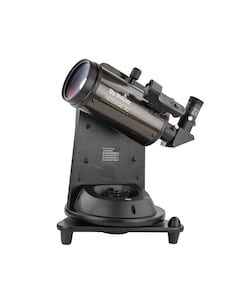
The SkyWatcher MAK-90 Virtuoso offers a significant step up in optical performance through its 90 mm Maksutov-Cassegrain design. Sharp, high-contrast images of the Moon and major planets, a compact and portable body, and a motorised Virtuoso alt-az mount that can be controlled via smartphone make this a strong choice for the dedicated beginner who wants to observe regularly and develop the hobby.
Best for: regular observers focused on the Moon and planets, beginners wanting to progress beyond entry-level equipment.
Above £300 — serious capability
The Sky-Watcher Star Discovery MAK 102 combines a 102 mm Maksutov-Cassegrain optical system with Go-To computerised tracking and Wi-Fi control. The Go-To mount finds and automatically follows any object from a database of tens of thousands — a significant advantage when learning the sky and wanting to spend observation time looking rather than searching. It performs very well on the Moon, planets, double stars, and the brightest deep-sky objects, and is capable of basic astrophotography.
Best for: ambitious beginners, astronomy enthusiasts who want computerised tracking, and anyone interested in both visual observing and trying astrophotography.
What to avoid — the most common telescope buying mistakes
The right first telescope should make you want to go out and observe again. The wrong one often sits in a corner after a few frustrating evenings. These are the mistakes most worth avoiding:
- Telescopes sold on magnification figures — a "400× telescope" with a tiny aperture is a marketing number, not a useful specification. At those magnifications, the image will be dark, blurred, and almost unusable. Aperture always matters more than the magnification claim on the box.
- Buying too large for your situation — a large Dobsonian reflector offers outstanding performance, but if carrying it from the house to the garden on your own is difficult, it will be used far less often. The telescope you actually take outside regularly will teach you more astronomy than the one that stays in the spare room.
- An unstable mount or wobbly tripod — vibration makes high-magnification views of the Moon and planets uncomfortable or impossible to use. A stable mount matters as much as the optics. If you find a telescope whose tripod feels flimsy when you tap it, that instability will be a constant irritant in use.
Beginner telescopes at MILITARY
MILITARY offers both compact entry-level telescopes for those just beginning their astronomical journey and larger instruments for more demanding night sky observations. The range includes lightweight refractors well suited to the Moon and planets from a suburban garden, as well as reflectors with larger apertures for observing nebulae, galaxies, and star clusters from darker skies.
The best telescope for a beginner does not have to be expensive or technically complex. It does need to match the type of observing you intend to do and be easy enough to use that you actually take it outside. A well-chosen instrument that you use regularly on the Moon, the planets, and the brightest deep-sky objects will teach you more in a year than a larger, more demanding telescope that stays packed away.