Česká republika
 Deutschland
 Österreich
 United Kingdom
 Suomi
 France
 Magyarország
 Italia
 Polska
 România
 Україна
 Europe

Which Gaiters to Choose? Walking, Running and Military Gaiters

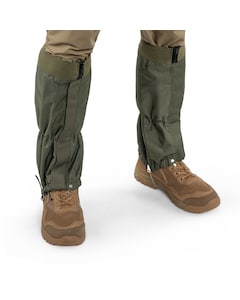
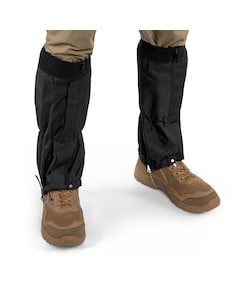
Gaiters are protective covers worn over your boots and the bottom of your trousers. They keep out snow, mud, sand and small stones – and they are useful all year round, not just in winter: on summer hill walks, on trail runs and on woodland paths after rain. Models differ in height, material and how they attach to the boot. So which gaiters should you choose, and how do you make sure they fit your footwear properly?
TL;DR
- Gaiters protect your boots and trouser legs from snow, mud, sand and stones – they are useful all year round, not just in winter.
- They don’t replace waterproof boots – if your footwear leaks, gaiters alone won’t keep your feet dry.
- Walking gaiters (around 35–45 cm tall) are the most versatile choice for hill walking and mixed conditions.
- Running gaiters are low, light ankle gaiters – they mainly keep out sand and grit.
- Military gaiters focus on durability (e.g. Cordura 500D), subdued colours and a secure fit.
- When choosing, check the manufacturer’s size chart, the size of your boot upper and your calf circumference.
What are gaiters and what are they used for?
Gaiters – sometimes called leg gaiters or boot gaiters – are protective covers that stop snow, mud, sand and small stones getting into your footwear. They also keep your trousers clean and dry when you are walking over wet ground. Depending on the model, they reach just above the ankle, halfway up the calf or almost to the knee. Bear in mind that gaiters don’t replace waterproof boots: if your footwear leaks through the upper or the seams, gaiters alone won’t keep your feet dry.
Gaiters really come into their own on hill walks, especially in winter and in spring and autumn, when the paths are covered in snow or mud – think boggy moorland in the Lake District or the Scottish Highlands. They are also popular with trail runners, anglers, foragers and anyone taking part in military training or airsoft. They work just as well for walks through wet grass, along woodland paths and anywhere else your boots and trouser legs are exposed to dirt and moisture.

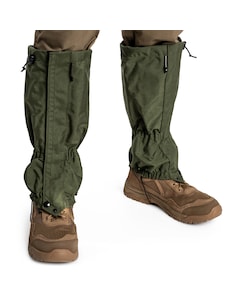

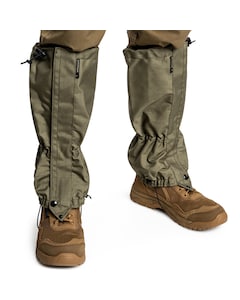

Types of gaiters – which to choose for your activity?
Gaiters differ mainly in height, weight, durability and how well they protect against water. The best choice depends on the conditions you will use them in most often.
Walking gaiters – for hill walking and mountain trails
Walking gaiters (also called trekking gaiters) are the most versatile group. They usually reach halfway up the calf or just below the knee, so they are around 35–45 cm tall. That is enough to protect your boots and trouser legs on muddy paths, in wet grass or in shallow snow, without restricting your movement on steep ascents and descents.
Durability is the key factor here. The lower part of the gaiter rubs against rocks, roots, heather and scrub, so manufacturers use tougher fabrics there, often with a polyurethane coating or extra reinforcement. The upper part can be lighter and more breathable. Good walking gaiters attach securely: a tough strap or cord under the sole, a metal hook for the laces and an adjustable drawcord at the top.
Walking gaiters work for most of the year – from wet autumn days and winter walks in the hills to the spring thaw, when paths turn into streams of mud. If you only want to buy one pair for mixed conditions, tall walking gaiters are the most sensible choice. It is also worth checking that your walking boots work well with gaiters.
Running gaiters – lightweight ankle gaiters for trail running
Running gaiters (also called trail gaiters) are a completely different category. Weight and freedom of movement come first, so running models are low ankle gaiters – usually reaching just a few centimetres above the ankle – made from thin, stretchy materials such as Lycra, spandex or lightweight nylon with elastane. A pair often weighs just a few dozen grams and fits easily in a running vest pocket.
Their job isn’t to keep out deep snow or heavy rain, but small debris: sand, grit, pine needles, small stones and bits of bark. These get into running shoes very easily, because trail shoes have a low, soft upper and often a mesh tongue. A single piece of grit can cause a painful blister after just a few kilometres.
Running gaiters also attach differently. Instead of a thick strap under the sole, many models use:
- a Velcro patch stuck to the heel of the shoe – the gaiter attaches to it at the back and hooks onto the laces at the front,
- a thin strap under the midfoot – lighter and more flexible than on walking gaiters,
- dedicated attachment points on the shoe – some running shoe brands fit a Velcro tab or gaiter hook on the heel at the factory, designed for gaiters from the same brand.
Military gaiters – for demanding terrain
Military gaiters are designed for harsh conditions, including training on a military range, long marches through woodland and crossing boggy ground. That is why the durability of the fabric, abrasion resistance and a secure fit to the boot matter most. Many models use tough fabrics such as Cordura 500D, with reinforcement in the areas most prone to wear.
Military gaiters usually come in subdued colours such as olive, coyote or RAL 7013, as well as in various camouflage patterns. Some models have IRR properties, which reduce the contrast of the fabric against the surroundings when viewed through night-vision devices. However, this isn’t standard on all military gaiters.
The fit to your military boots is also very important. The gaiters should sit snugly against the upper and stay in place when you march, run or tackle obstacles. Adjustable straps under the sole, lace hooks and top drawcords all help here. If you are putting together kit for this kind of use, also take a look at our military boots.

Hazard 4 Mandogator Modular Tactical Boot Gaiters - Coyote
Waterproof gaiters – Gore-Tex and coated models
Waterproof gaiters are made either from fabric with a polyurethane (PU) coating or from a laminate with a waterproof, breathable membrane such as Gore-Tex. The membrane keeps water out while letting the water vapour produced when you exercise escape, so membrane gaiters stay more comfortable over long periods in wet conditions.
Gore-Tex gaiters are particularly effective on long walks in rain, wet snow or through soaking vegetation. Compared with simple gaiters with a non-breathable coating, they reduce the build-up of moisture under the fabric more effectively. That doesn’t mean they eliminate sweat and condensation completely, especially when you are walking hard.
How to choose gaiters for your boots?
When choosing gaiters for boots, the most important things are the size and shape of your footwear, your calf circumference and the height of the gaiters. Gaiters that are too loose can slip while you walk, while ones that are too tight will restrict your movement and be hard to fit properly over your boots.
First, check the manufacturer’s size chart, because S, M and L don’t mean the same thing for every model. Look at the width and height of the boot upper – chunky walking or winter boots may need larger gaiters than lightweight trail shoes in the same size. Calf circumference also matters, especially for tall gaiters. The top edge should sit snugly against your trouser leg without pressing on it or restricting knee movement.
The adjustment range is just as important. Drawcords and straps should let you get a stable fit around both the boot and the trouser leg. Many models have a unisex design, so when choosing women’s or men’s gaiters, go by the actual measurements rather than just the product label.
Gaiters – Frequently Asked Questions (FAQ)
Do you need gaiters in summer?
Yes, although for different reasons than in winter. In summer, gaiters mainly keep out sand, grit, dust and small stones – especially on dry, rocky paths, scree slopes and trail runs. They are also handy first thing in the morning when the grass is wet with dew, when walking through tall vegetation, bracken and bushes, and after summer downpours when paths turn to mud.
Can you wear gaiters with walking shoes or trainers?
Yes, many gaiters work with low walking shoes and trail trainers. Short ankle gaiters are usually best for running and summer walks. Check, however, that the attachment system suits your sole and laces. In deep snow, low shoes may not give enough protection, even with tall gaiters.
How do you put on gaiters?
Put your boots on first. Wrap the gaiter around your lower leg with the opening at the front or side (depending on the model) and do up the zip, Velcro or poppers. Hook the front hook onto your lowest lace, pass the strap under the instep of the sole and fasten it, then tighten the drawcord at the top. Your trousers can go inside or over the gaiter – inside gives better protection against water running down into your boots.
Do gaiters replace waterproof boots?
Partly. Waterproof gaiters – with a PU coating or a membrane – protect the bottom of your trousers and the top of your boots from rain, puddles and wet vegetation. They also stop water from soaked trousers running down into your boots, which is one of the main causes of wet socks in prolonged rain. However, they don’t replace waterproof trousers, because they only cover the calf and ankle. In very heavy rain, the best combination is waterproof boots, gaiters and waterproof trousers. Gaiters without a waterproof coating, such as stretchy running gaiters, won’t protect you from rain at all.
How do you clean and look after gaiters?
After every walk, remove mud, sand and other dirt. Most gaiters can be cleaned with a damp sponge or soft brush, following the manufacturer’s instructions. Make sure they are completely dry before you put them away. Check the straps, cords, zips and Velcro regularly too. For gaiters with a water-repellent finish, you may need to reproof them with a DWR treatment from time to time.
Gaiters at MILITARY
In our gaiters category you will find gaiters for every use: durable walking gaiters for the hills, tall models for winter and military gaiters in camouflage colours. The range includes heavy-duty Cordura models for intensive use in the woods and on the training area, as well as lighter gaiters for walking. For each product you can check the material, fastening method and size chart, so it is easy to match the gaiters to your boots.