 Česká republika
  Deutschland
  Austria
  United Kingdom
  Suomi
Suomi  France
  Magyarország
  Italia
  Polska
  România
  Україна
  Europe
How to choose trekking poles for the mountains? - a practical guide
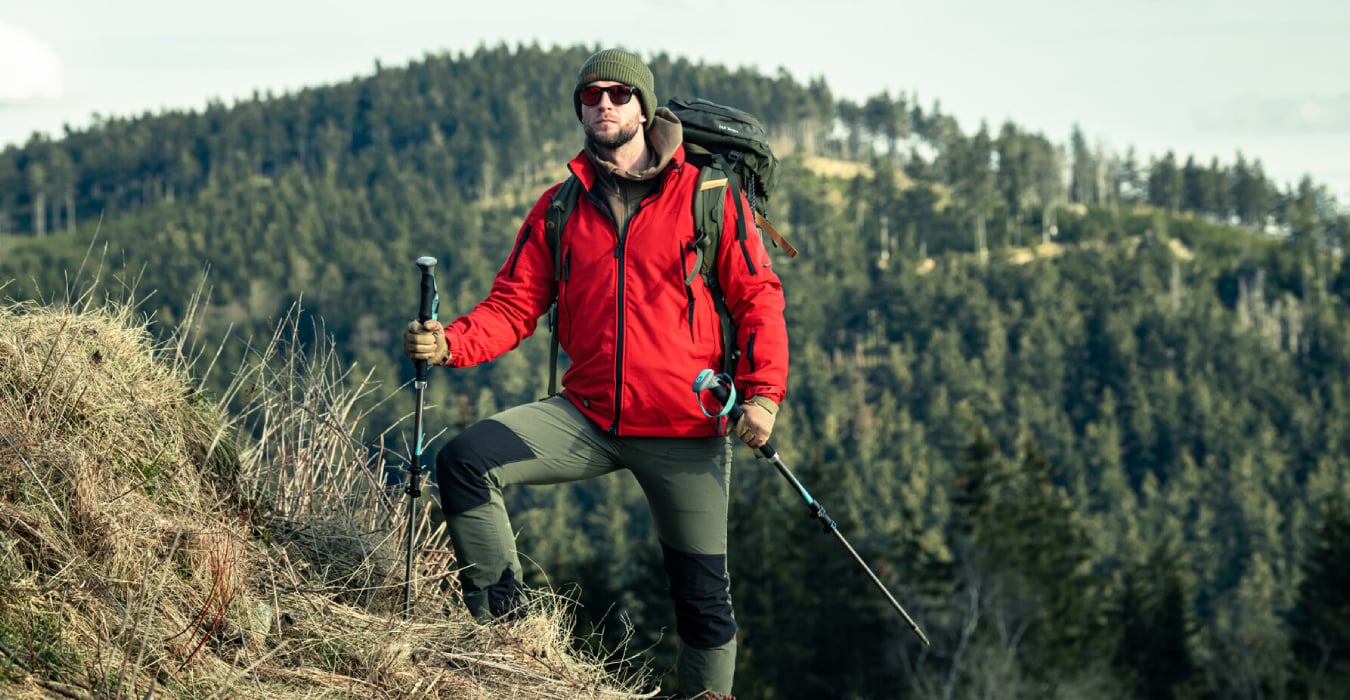
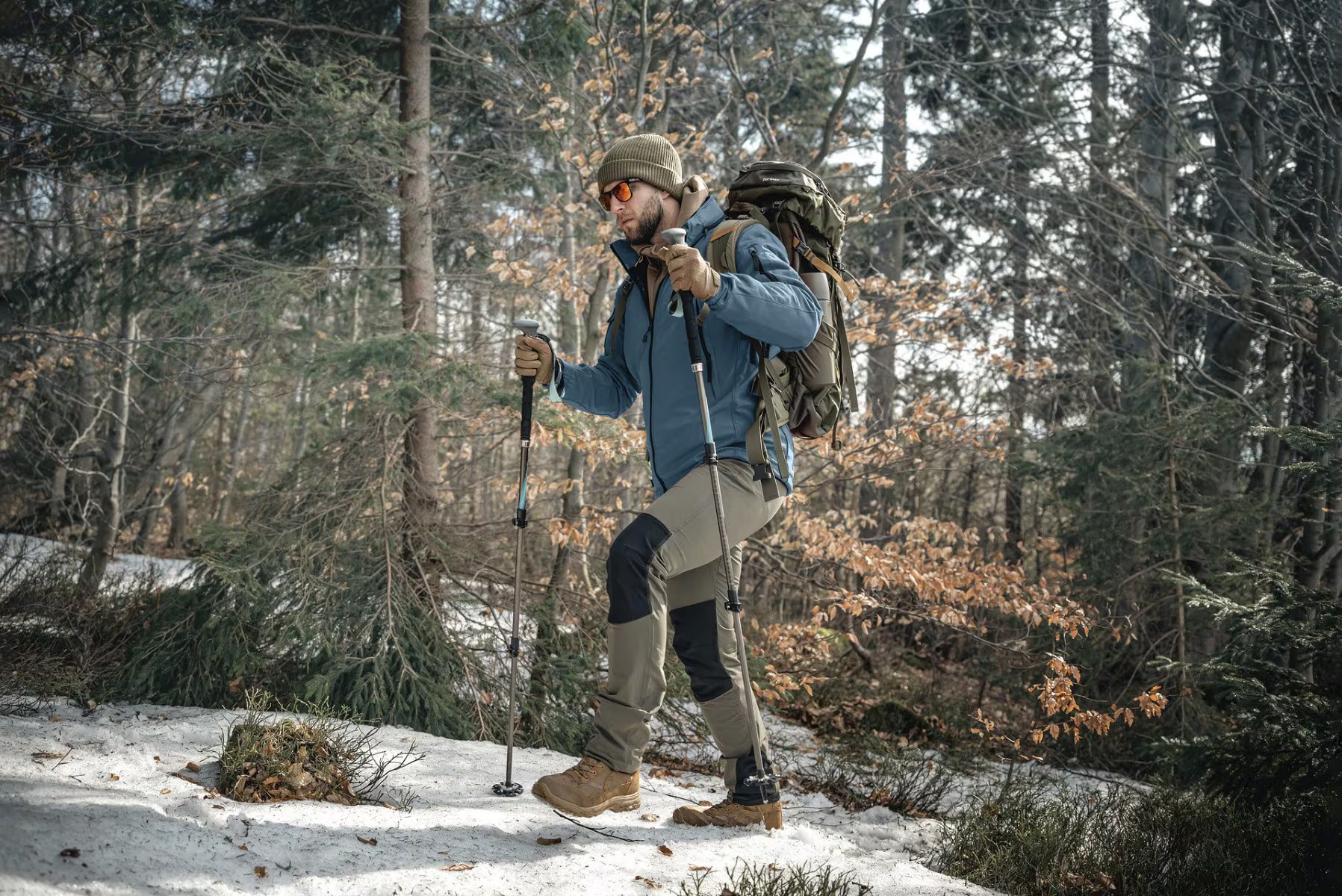
In recent years, trekking poles have become very popular among mountain hiking enthusiasts. More and more people take them on the trail — and it's no wonder. Properly chosen, they improve walking comfort, relieve joints, and make it easier to tackle steep ascents.
Are you wondering exactly what trekking poles are and how they can improve your comfort during mountain hikes? Read our guide, in which we explain what trekking poles are and what benefits they bring during mountain trips. We suggest how to choose trekking poles according to height, how many segments will be appropriate, and what to pay attention to when choosing ends, handles, and locking systems. Additionally, we have prepared a FAQ section where you will find answers to the most frequently asked questions, including how to use trekking poles correctly.
What Are Trekking Poles?
Trekking poles are nothing but a pair of specially designed sticks that are meant to aid the body's work and serve as additional support while walking. When you cover many kilometers with a heavy backpack, they help relieve the spine, hips, knees, and feet. They reduce the risk of injuries, strains, and painful trauma. They also improve your posture – you don't hunch, you walk upright, breathe more easily, and tire less quickly. As a result, you can hike faster, longer, and more enjoyably, even on demanding terrain.


Trekking Pole Height Chart - How to Choose Poles According to Height?
If you plan to purchase trekking poles for the mountains, it is very important that they are properly matched to your height. To do this, you can use a simple formula: height × 0.68 or 0.72 (depending on the intensity of mountain walking). Example: 170 cm × 0.68 = 115.6 cm (so it's best to choose poles 115 cm in length after rounding). A correctly chosen trekking pole should form a right angle (90 degrees) with the forearm when the elbow is bent.
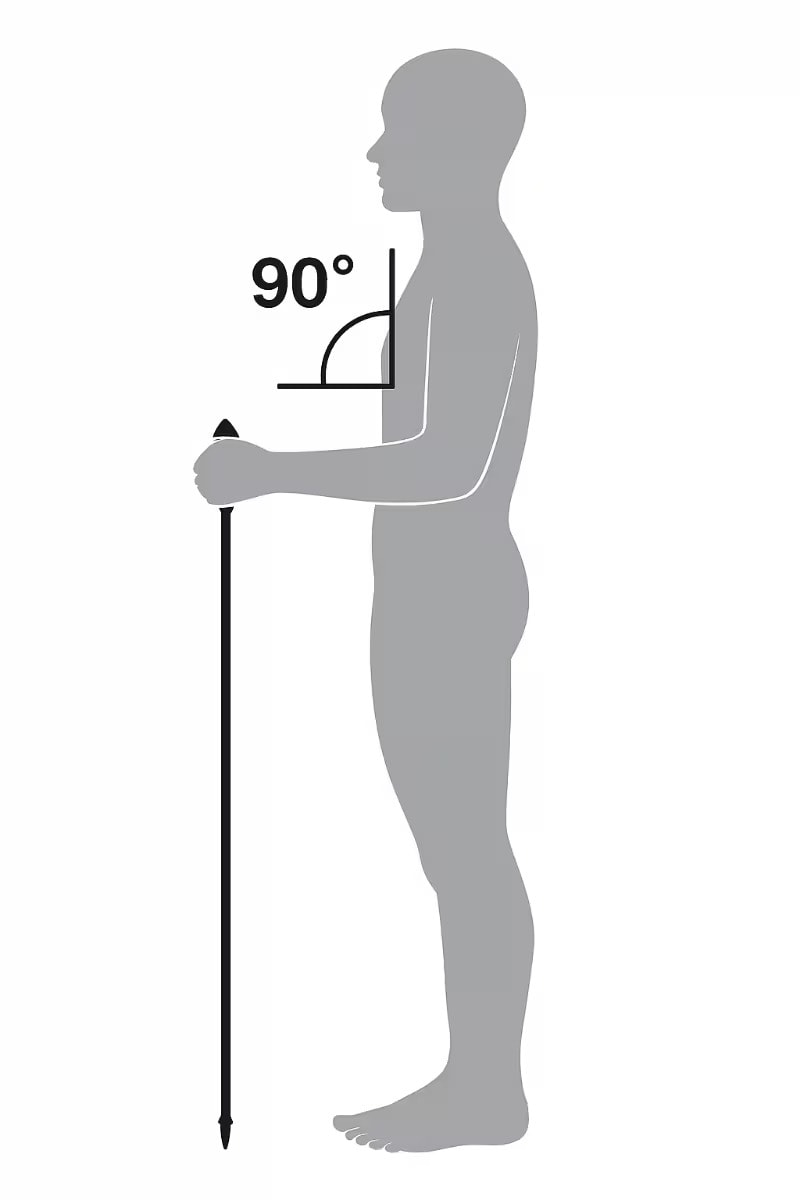
We also present it based on a sample trekking pole height chart that shows the recommended pole length depending on a person's height:
| Trekking Pole Height Chart | |
|---|---|
| Person's height | Recommended pole length |
| 145 - 152 cm | 100 cm |
| 153 - 161 cm | 105 cm |
| 162 - 167 cm | 110 cm |
| 168 - 173 cm | 115 cm |
| 174 - 180 cm | 120 cm |
| 181 - 186 cm | 125 cm |
| 187 - 194 cm | 130 cm |
| >195 cm | 135 cm |
Which Trekking Poles to Choose – Two, Three, or Four-Section?
When choosing trekking poles, it is also very important to select their appropriate construction – two-section, three-section, or four-section (also called folding or Z-pole when the sections are joined by an internal cord). This significantly affects, for example, how compact the poles will be when folded, which is especially important in situations where they cannot be used in the mountains and need to be stored or attached to a backpack. Differences between pole constructions:
- Two-section trekking poles – these are the simplest poles that provide the best stability, but they have considerable size when folded. When attached to a short backpack, they can protrude, making carrying them less convenient.
- Three-section trekking poles – these are among the most popular models found on mountain trails. Compared to two-section poles, they take up much less space when folded.
- Four-section (Z-pole) trekking poles – these are the ideal choice for those who prioritize convenient transport of poles. When folded, they take up very little space, but this may often come with a higher total weight. Moreover, since they consist of four elements, they may be less stable.
In summary, if you care most about the stability of poles, choose a two-section model. However, if you are looking for trekking poles that you can easily fit in a backpack or attach to it so that they don't interfere during the march, opt for three-section or four-section models.
Choosing Trekking Poles for the Mountains – What Else Is Worth Considering?
Choosing trekking poles is not as simple a matter as it might seem. There are many important issues worth considering for the equipment to perform well in the field. Poorly selected poles may turn out to be uncomfortable or even hinder walking during a mountain expedition, so it's worth approaching the purchase consciously.
Durability
An excellent choice is trekking poles made of carbon fiber – exceptionally light and durable, although their price is higher. A cheaper alternative is aluminum models, which offer good durability at a slightly higher weight. Carbon fiber poles may crack under heavy load, whereas aluminum ones tend to bend under pressure, but are less likely to break.
Locking Systems: Twist Lock vs Flip Lock
Various locking systems are available in trekking poles, affecting their functionality and ease of use:
1. Twist lock — for many years, it was a popular choice, but nowadays it gives way to newer solutions. This system relies on twisting two adjacent sections to lock them in place, using an internal expanding mechanism. Using poles with this system can be troublesome in low temperatures. Using this system is also rather problematic with thick gloves. The mechanism sometimes unlocks itself, causing the poles to collapse unexpectedly.
2. Flip lock (clamp lock) — more and more frequently, poles with a flip lock (also called clamp or lever lock) are chosen, characterized by greater reliability, easier operation, and better resistance to external factors. Such external clamps are particularly practical in winter conditions when operations are performed in gloves. If the clip in such a pole becomes loose or tight, it can be easily adjusted.
3. Push-button lock — one of the most advanced solutions is a system inspired by avalanche probes, allowing quick and easy unfolding of poles while reducing their weight. This type of mechanism is popular among trail running enthusiasts. However, keep in mind some models with this system have limited length adjustment and offer only a fixed length when unfolded.
Folding Method of the Pole: Telescopic vs Z-Fold
The choice of trekking poles often involves deciding on the method of folding. There are two main systems that differ in functionality and practicality depending on the situation — telescopic poles and Z-fold poles:
- Telescopic pole — constructed so that individual elements nest inside each other. The advantage of this system is the ability to adjust the pole length depending on needs. It is more versatile, ideal for those going on mountain excursions and long-distance trails. Thanks to the adjustment, it can also be used, for example, to set up a tent.
- Z-fold pole — differs from the telescopic pole because it contains a cord inside that permanently connects all elements. In these poles, there is usually no option for adjusting the length freely. However, they are significantly smaller when folded and lighter than telescopic poles.
Handle
This is an important consideration when choosing trekking poles for the mountains, which should not be overlooked. Various materials are available on the market, such as:
- Rubber – provides very good grip both on bare skin and in gloves. It is durable and abrasion-resistant.
- Synthetic foam (EVA) – a lightweight, porous polymer material that absorbs moisture well, ensuring a secure grip even with sweaty hands.
- Cork – a natural and eco-friendly material growing in popularity. It is soft, pleasant to the touch, and absorbs moisture well, which is especially useful on hot days.
Tip and Basket
In the mountains, trekking poles with tips made of carbide (tungsten carbide) will work best. This material is exceptionally wear-resistant, providing stability and good grip on the ground. Tungsten carbide tips are much harder than steel, even several times over. We also recommend choosing trekking poles where the tips can be replaced.
It's also worth paying attention to the basket, a ring placed just above the tip. Its function is to prevent the pole from sinking into soft ground like snow, mud, or loose gravel. Depending on the conditions, different basket sizes are available – smaller ones are suitable in the summer on hard terrain, and larger ones in winter or on muddy ground.
Shock Absorption
In some models of trekking poles, manufacturers introduce shock absorption (anti-shock) systems that reduce vibrations generated with each ground contact of the pole. As a result, the poles can relieve the joints more and improve comfort.
Frequently Asked Questions about Trekking Poles (FAQ) – Everything You Need to Know
In this section, we have gathered answers to the most frequently asked questions about trekking poles that appear online and in conversations with people planning hikes.
Trekking Poles vs. Nordic Walking Poles
Trekking poles and Nordic walking poles differ primarily in purpose and construction. Trekking poles are heavier, more durable, and have hard tips – ideal for mountain trails. Nordic walking poles are lighter, often of fixed length, and are better suited for walks on flat terrain.
Can Trekking Poles Be Carried in Hand Luggage?
No, trekking poles are usually not allowed in hand luggage as they can be considered dangerous items. The airline may classify them as a tool that could harm passengers.
How to Use Trekking Poles Correctly?
Trekking poles should be held so that they are slightly bent when touching the ground, with the tip pointed slightly backward – toward the user. The hand should pass through the strap from below, stabilizing the grip and preventing the pole from slipping from the hand, ensuring comfort and safety during the march.
When ascending, poles should be shortened, and when descending – lengthened. An alternative is poles with a long handle, allowing a quick hand movement lower without adjusting the length.
Trekking Pole Offer at MILITARY.EU
Unsure which trekking poles to choose? The MILITARY.EU store offers trekking poles from brands such as Rockland, Highlander, Volven, and Fjord Nansen. We offer two-section and three-section models made of aluminum, carbon fiber, and fiberglass.
Selected models of trekking poles are equipped with anti-shock vibration absorbing systems, which increase comfort by reducing shocks during the march. Models with an external flip-lock (Twist-Lock) blocking system are also available, allowing quick and easy unfolding and blocking of the pole. We warmly invite you to explore our store's full offer.